Borosilicate Brilliance: Glass Cookware That's Truly Non-Toxic
About Misen
We make kitchen tools that work better, last longer, and cost less than you’d expect: everyday innovations with a radical focus on our customers’ actual need.
Table of Contents
Summary
Borosilicate Brilliance demystifies why laboratory-grade borosilicate glass has become the gold standard for cooks who refuse to trade convenience for health, explaining how its unique silica-and-boron formula creates a surface that is chemically inert, thermal-shock resistant, and utterly free of the lead, cadmium, PFAS, and nickel that can leach from metals, ceramics, or soda-lime glass. Readers learn to spot authentic borosilate by weight, clarity, and brand certifications, compare saucepan, casserole, and bakeware sets for every stove type (including induction disks), and master the simple rituals--sudden-temperature avoidance, nylon-tool use, and a quick baking-soda polish--that let these pans last decades while never ghosting flavors or staining. The article also decodes lid fits, handle ergonomics, oven-safe thresholds, and storage tricks that turn a modest three-piece set into the workhorse of a minimalist, plastic-free kitchen. By the final sentence, the guide has armed home cooks with the confidence to replace scratched non-stick and mystery-coated sheets with transparent cookware that can travel from freezer to 500 degreesF oven, deliver restaurant-level browning, and go straight to the table in Instagram-ready elegance--proving that the safest pan is also the most versatile and, over time, the most economical.
Understanding Non‑Toxic Borosilicate Glass Cookware
Swap your scratched non-stick and plastic cookware for borosilicate glass--its silica-and-boron solid surface never leaches PFAS, BPA, lead, or cadmium, no matter how hot or acidic your cooking gets.
What Makes Borosilicate Glass Non‑Toxic
Borosilicate glass is special because of what it's made from: silica and boron trioxide. [1] Together, these create a material that simply doesn't react with your food. That means no BPA, phthalates, lead, or cadmium leaching into your meals -- even when you're simmering tomato sauce or baking at high temperatures. [2] The non-porous surface is another big win.
Unlike plastic or lower-grade cookware that develop tiny scratches over time (where bacteria and odors love to hide), borosilicate stays smooth and clean. [3] This matters because cooking puts materials through a lot -- heat, acids from food, constant use. While other materials break down under these conditions, borosilicate just keeps performing.
How It Outperforms Common Toxic Alternatives
Let's talk about what most of us have in our kitchens right now. Nonstick pans -- even the ones labeled "PFOA-free" or "nontoxic" -- often contain other PFAS compounds. These "forever chemicals" don't break down in your body or the environment, and they're linked to serious health issues when released through heating. [4] Plastic cookware? Even "microwave-safe" versions can leach BPA and phthalates when heated.
And those BPA-free alternatives? They often use BPS instead, which has similar hormone-disrupting effects. [4] Ceramic-coated pans seem like a good middle ground, but here's the catch: their safety depends entirely on that coating staying perfect. Once you get those inevitable micro-scratches, the aluminum underneath can start transferring into your food. Lower-quality glazes might also contain lead or cadmium that leaches out with heat and use. [5] Borosilicate glass sidesteps all these problems.
There's no coating to scratch off, no plastic layer to break down, no metal hiding underneath. Just one solid material that works the same way on day one as it does years later. [5] That's the kind of reliability you want when you're feeding your family.
Everyday Advantages of Non Toxic Borosilicate Glass Cookware
Borosilicate glass cookware gives you steady, even heat for richer flavors, a crystal-clear view to prevent over-cooking, and a non-shedding, endlessly recyclable surface that outlasts--and outgreens--any scratched-up nonstick pan.
Consistent Heat Transfer for Better Flavor
Glass functions as an insulator rather than a conductor -- it heats slowly, but once at temperature, it holds that heat uniformly without the localized spikes that cause proteins to seize, sauces to scorch, or crusts to brown unevenly on one side. [6] For dishes that reward patience -- casseroles, custards, braises -- that slow, even thermal environment is an asset rather than a limitation, since consistent exposure to heat is what allows flavors to develop fully rather than cook off quickly under erratic temperatures.
The transparent walls add a practical edge on top of that: you can see the bottom and sides of a dish as they cook, so you can pull a pie crust at exactly the right level of browning or catch a liquid before it over-reduces, all without lifting a lid and disrupting the cooking environment. [6] And because borosilicate glass is chemically non-reactive with food even under sustained heat, it won't introduce competing flavors -- what you taste reflects only the ingredients. [7]
Scratch‑Resistant Durability Reducing Waste
Borosilicate glass doesn't degrade the way coated cookware does -- its scratch-resistant surface holds up under regular use without pitting, warping, or losing structural integrity, meaning you're not replacing it every few years the way you would a nonstick pan. [8] That longevity compounds into a real environmental advantage: a 2022 Ecology Center report found that 79% of nonstick pans are coated with PTFE, and once those coatings begin to scratch, they can release up to 2,300,000 microplastics per use -- particles that persist in ecosystems indefinitely. [8] Borosilicate glass eliminates that failure mode entirely because there's no coating to shed.
It's also 100% recyclable at the end of its lifespan, unlike most composite cookware that can't be separated into recyclable components. [8] The result is cookware that reduces kitchen waste on two fronts: it lasts long enough that you rarely need to replace it, and when you eventually do, it doesn't become landfill. [8]
Choosing the Right Borosilicate Set for Your Kitchen
Before you buy, flip the glass to the light--if the edge glows green it's soda-lime that'll shatter in your oven, while crystal-clear, ISO-3585-certified European borosilicate with 5% boron trioxide survives 165 degreesC swings and keeps toxins out of your food.
Key Features to Look For
The biggest mistake when shopping for glass cookware is trusting "heat-resistant" labels alone -- that term gets applied to regular soda-lime glass that can't handle the temperature changes borosilicate manages effortlessly. [9] Real borosilicate glass contains at least 5% boron trioxide, which creates its signature ability to withstand extreme temperature shifts (up to 165 degreesC) without cracking. [9] Here's a quick visual test: hold the glass up to light and check the edge -- if you see a bluish-green tint, it's soda-lime glass; genuine borosilicate has a clear, colorless edge. [10] But don't rely on visuals alone.
Request documentation showing ISO 3585 certification and heavy metal testing to confirm the glass is truly lead and cadmium-free -- as we covered earlier, these toxins have no place in cookware. [9] Manufacturing origin matters too: European-made glass and products from well-regulated facilities typically offer more reliable safety certifications. [1] One practical note for modern kitchens: standard borosilicate won't work on induction cooktops unless it includes a magnetic base layer, so verify compatibility with your cooking setup before purchasing. [9]
Affordable Quality Without Compromise
Quality borosilicate cookware doesn't require breaking your budget -- the key is understanding what actually affects performance versus what's just marketing.
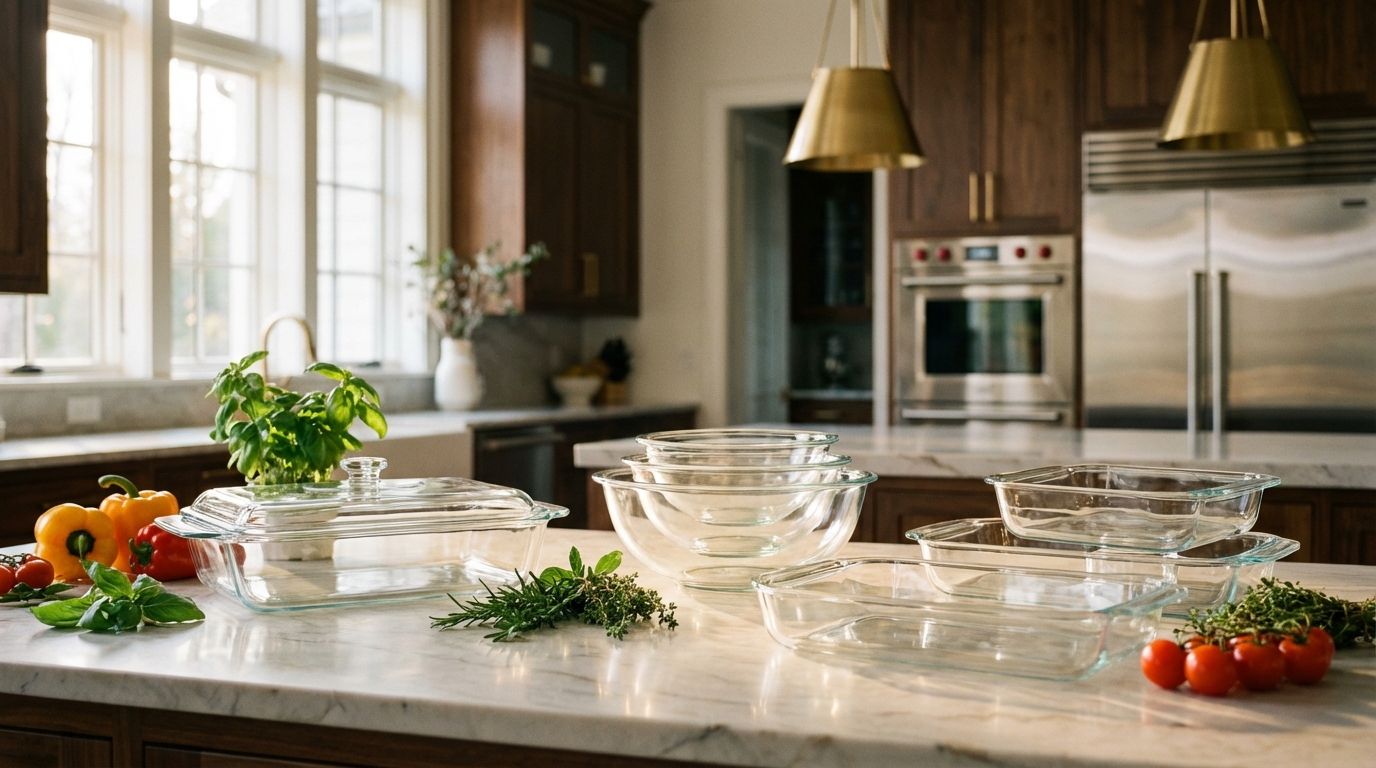
Look for brands that openly share their glass composition and safety testing results, regardless of price point. [11] The best value comes from manufacturers who focus on the fundamentals: proper borosilicate composition, reliable thermal resistance, and practical design for everyday cooking. [11] When evaluating options, ask whether the manufacturer provides documentation confirming their glass meets true borosilicate standards -- transparency about materials and testing is often more important than brand recognition. [11] For most home cooks, a well-chosen starter set covering essentials like baking dishes, a covered casserole, and multipurpose bowls delivers everything you need without overpaying for unnecessary features.
Understanding what makes quality cookware helps you invest in pieces that perform reliably for years rather than constantly replacing cheaper alternatives that fail under regular use.
Care, Maintenance, and Maximizing Lifespan
Treat your borosilicate cookware to gentle cleansers, gradual temperature changes, and cushioned storage, and it will deliver a lifetime of safe, sparkling service.
Simple Cleaning and Safe Use Tips
Borosilicate's non-porous surface means most residue releases with just warm water and a soft sponge -- you won't need to scrub after everyday cooking. Skip the abrasive pads and harsh cleaners; they don't clean glass any better, but they will leave micro-scratches that dull your cookware over time. [12] For baked-on grease or stubborn stains, two approaches work without damaging the glass: either make a paste of baking soda and water, apply it to the stained area, and let it sit for 20 minutes before gently scrubbing, or fill the dish with equal parts white vinegar and water and soak for an hour to loosen stuck residue. [13] Both methods avoid the chemical exposure that comes with commercial oven cleaners.
When running borosilicate through the dishwasher, skip the heat-dry cycle -- the sustained concentrated heat can stress the glass over repeated cycles; air-dry or crack the door after the wash cycle instead. [14] Here's the most important safety rule: never move your glass dish directly from hot to cold. Taking it straight from the oven to a cold counter, cold water, or the fridge creates stress that can crack even the strongest borosilicate glass. [13] Always let it cool on a trivet or folded towel first -- even quality tools like silicone trivets protect both your cookware and countertops.
Storing and Repairing to Extend Life
How you store borosilicate cookware determines how long it lasts between uses. Never stack glass pieces directly on each other -- the hard surfaces create stress points that turn into chips and cracks over time.
A simple folded cloth or silicone liner between pieces prevents that damage completely. [15] Before you put any piece away, inspect it briefly for chips, hairline cracks, or weakened joints -- these defects compound under heat, and a small chip that seems cosmetic today can propagate into a full fracture mid-cook. [15] Found a chip or crack? Repair might be easier than you think.
Professional borosilicate glass repair can restore damaged pieces to their original strength, and the fix is usually invisible -- your cookware stays just as clear and strong as before. [16] You'll save significantly too; repairs typically cost 60% less than replacement, making it worthwhile for pieces you love using. [16] For pieces with sentimental or practical value, repair extends usable life far beyond what periodic replacement allows.
Key Takeaways
- Borosilicate glass withstands thermal shock up to 300 degreesC without leaching chemicals.
- It is free of lead, cadmium, BPA and PTFE found in some metal or coated pans.
- Transparent walls allow monitoring food and reduce overcooking or burning risk.
- Oven, microwave, freezer and dishwasher safe, eliminating multiple dish transfers.
- Thicker, lab-grade formulation resists scratching and keeps flavors neutral.
- Sudden temperature swings or direct stovetop heat can crack borosilicate pieces.
- Hand washing with non-abrasive pads prolongs clarity and prevents etching.
References
- https://eatbeautiful.net/borosilicate-glass-cookware-the-best-pot-youre-not-using-yet/
- https://slyprc.com/what-is-borosilicate-glass-made-of-why-safer-food-contact/
- https://www.glasafe.com/blogs/glasafe-blogs/why-choose-non-toxic-borosilicate-glass-over-regular-glass?srsltid=AfmBOooXdgPX-FmPrVDZ2oAymMRqwV9UUDyVAuIbECBIyaGiPD4NajlH
- https://www.bcpp.org/our-work/tips-for-prevention/safer-cookware-guide/
- https://www.alibaba.com/product-insights/glass-cookware-vs-ceramic-is-one-actually-safer-for-everyday-cooking.html
- https://www.joyye.com/info-detail/glass-vs-ceramic-bakeware
- https://www.lemon8-app.com/@glassware_manufacturer/7530201372042527287?region=us
- https://www.safecoze.com/blog/switch-to-non-toxic-borosilicate-cookware/
- https://www.alibaba.com/product-insights/how-to-choose-borosilicate-glass-cookware-a-complete-buying-guide.html
- https://www.crystaliausa.com/blogs/blog/everything-you-need-to-know-about-borosilicate-glass?srsltid=AfmBOop6Dw3BtTCCxSM5d6BLmyoTAro--bQi_BXGjh092YftdJbS04Oe
- https://kitchenbap.com/borosilicate-glass-cookware-brands/
- https://www.glasafe.com/blogs/glasafe-blogs/caring-of-glassware-clean-maintain-store-borosilicate-glass?srsltid=AfmBOorS3qEG-3_acpa734uw514XAmQrR1cjXhGefS8sjALSsgBOaxFf
- https://www.leheglass.com/info/how-to-clean-high-borosilicate-glass-baking-pa-93523608.html
- https://myborosil.com/blogs/tips-tricks/how-to-care-for-and-maintain-your-glassware?srsltid=AfmBOorpI7paeNOYzntWK6azHCrhnLxANL8ho4Ea883Cc-vQCJZIdjlp
- https://yinghuadecookware.com/9-hacks-to-extend-the-life-of-glass-cookware.html
- https://www.ddpsinc.com/blog/repair-options-for-borosilicate-glass-components