Cutting-Board Woods Ranked by Blade Kindness
About Misen
We make kitchen tools that work better, last longer, and cost less than you’d expect: everyday innovations with a radical focus on our customers’ actual need.
Table of Contents
Summary
Choosing the right cutting-board wood is a balancing act between protecting your knives and protecting your health, and this guide shows you exactly how to nail it. You'll learn why the sweet-spot Janka range of 900-1,500 lbf keeps boards from gouging or dulling blades, why tight-grain domestic species such as maple, walnut, and cherry outclass both bacteria-trapping open-pore woods and glass-hard exotics, and how end-grain construction can stretch the time between knife sharpenings from three months to a year. The article ranks popular and specialty woods for "blade kindness," spells out the food-safety science that puts wood ahead of plastic, and delivers a maintenance playbook--wash both sides, oil with mineral oil, store on edge--that prevents warping, odors, and bacterial buildup. Armed with these insights, you can buy or build a board that keeps its surface smooth, your knives razor-sharp, and your food safe every single cut.
How to Choose the Right Wood for Your Cutting Board
Pick a tight-grain domestic hardwood like maple, walnut, or cherry--between 900 and 1,500 on the Janka scale--and its self-healing fibers will fight bacteria better plastic while keeping your knives sharp.
Hardness, grain, and food safety basics
Wood hardness drives every cutting board decision you'll make. The Janka scale measures how much force it takes to dent a wood species -- and for cutting boards, you want to stay between 900 and 1,500 lbf. Go softer, and your board will gouge easily, warp when wet, and trap bacteria in its porous surface. Go harder, and you'll feel it in your knife work -- the surface fights back, dulling your edges faster and making every cut more difficult. [1] The most popular cutting board woods -- maple, walnut, and cherry -- all fall right in that sweet spot, which we'll explore in detail below. [2]Grain structure matters just as much as hardness, though it's less obvious at first glance.
Open-pored woods like red oak and ash create problems even when their hardness seems right -- those visible pores trap food particles and moisture, inviting bacteria to set up shop. [1] Tight, closed-grain hardwoods work differently. When you cut into them, the fibers actually part and close back up -- a self-healing effect that reduces scarring and eliminates those tiny grooves where bacteria hide. [3]Here's something that might surprise you: wood actually beats plastic for food safety. Research from UC Davis and the University of Wisconsin proved that bacteria like E. coli and Salmonella die faster on wood than plastic.
Wood pulls moisture and bacteria below the surface where they're naturally neutralized, while plastic boards trap them in knife scars that washing can't reach. [3] Want a simple way to identify food-safe woods? If the tree produces something edible -- fruit, nuts, or maple syrup -- the wood is typically safe for your kitchen. That's why maple, walnut, and cherry dominate the cutting board world. Tropical exotics often contain natural compounds that can irritate skin or contaminate food, so stick with proven options.
How wood affects knife sharpness and durability
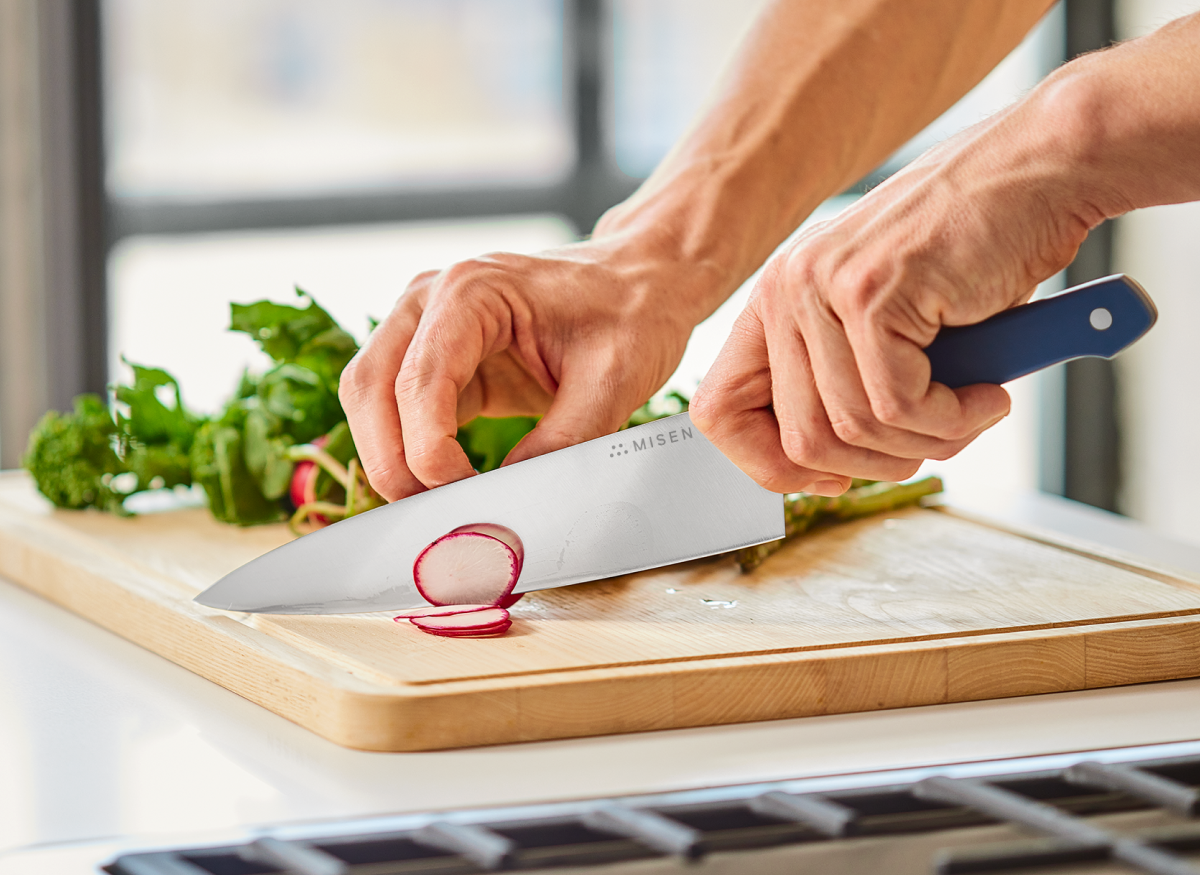
Grain orientation directly impacts how often you'll need to sharpen your knives. End grain boards -- where wood fibers point upward like a bundle of straws -- give slightly under your blade and spring back.
Your knife slips between the fibers instead of dragging across them, which dramatically reduces edge wear. Edge grain boards put fibers horizontal to the cutting surface, creating more blade resistance with every cut.
Face grain boards are toughest on knives -- that flat, rigid surface forces your blade into hard contact on every stroke. [4] The difference is real: cut daily on glass or ceramic and you'll lose up to 50% of your knife's sharpness in three months.
Top Domestic Woods Ranked by Blade Kindness
Choose hard maple end-grain boards for the safest, longest-lasting edge and the cleanest food prep surface, or opt for black walnut if you prize knife longevity over a pristine-looking board.
Maple - the top pick for blade kindness
Hard maple's 1,450 lbf Janka rating sits at the upper boundary of the ideal cutting board range, which creates a specific mechanical advantage: it resists deep gouges while its tight, closed grain produces a self-healing effect -- fibers compress under a blade and recover, limiting the surface scarring where bacteria take hold. [6] That behavior earned hard maple both FDA and USDA approval for commercial food preparation surfaces, and UC Davis research found maple boards reduced bacterial counts by 99.
9% within three minutes of exposure, outperforming plastic in repeated independent tests. [6] The one practical trade-off is color -- maple's light tone shows staining more readily than walnut or cherry, though that visibility also makes it easier to spot when the board needs cleaning, which is arguably more useful than stain concealment.
[7] Grain orientation still determines how much of maple's blade-kindness you actually get: end-grain construction lets a blade slip between vertical fibers rather than drag across them horizontally, so an end-grain maple board preserves an edge significantly longer than an edge-grain maple board will -- even though both use the same species.
Walnut - a balanced, knife‑friendly alternative
At 1,010 lbf on the Janka scale, black walnut sits near the lower boundary of the ideal cutting board range -- and that positioning is exactly what makes it appealing to cooks who prioritize knife preservation over surface longevity. The lower density creates measurable give under a blade: rather than resisting the edge, walnut absorbs impact stress, reducing the micro-chipping and edge rollover that accumulates fastest on harder surfaces. [8] That mechanical behavior makes it the preferred choice among cooks who sharpen frequently and want to extend time between sessions.
The trade-off is visible: walnut shows knife marks faster than maple, developing a well-used surface that some find characterful and others find worth sanding out periodically. [9] Its darker grain -- ranging from light tan sapwood to deep chocolate brown heartwood -- actively conceals staining from beets, red wine, citrus, and other colorful ingredients that would mark a lighter wood immediately, which has practical value beyond aesthetics. [10] Walnut's grain is slightly more open than maple's, meaning it absorbs oil more readily and benefits from oiling every three to four weeks rather than monthly -- skip that routine and the surface dries faster and becomes rougher underfoot for a blade.
[9] One other distinction worth noting: walnut costs roughly 15-25% more than comparable maple boards because the trees grow slower and supply is more limited, so the premium is structural, not cosmetic.
Exotic and Specialty Woods Worth Considering
Purpleheart's 2,520-lbf density makes it a stunning charcuterie board, not a knife-friendly prep surface, while wenge's hardness and gaping pores disqualify it from food-prep duty altogether.
Purpleheart - ultra‑hard for heavy use
Purpleheart sits at 2,520 lbf on the Janka scale -- nearly double the upper boundary of the ideal cutting board range -- and that single number explains most of what you need to know about using it. [11] The density that makes it resistant to scratches, moisture, and heavy impact also makes it genuinely punishing on knife edges, particularly thin Japanese carbon steel blades where edge rollover and micro-chipping accumulate fast.
[11] Its natural water resistance is a practical advantage in a wet kitchen environment, and it's generally considered food-safe in terms of toxicity, though the raw wood and its dust can cause dermatitis and lung irritation during cutting or sanding -- a consideration relevant to whoever makes or maintains the board, not just uses it. [11] Where purpleheart makes more sense is as a serving or charcuterie surface: occasional light cuts don't stress knife edges the way repetitive prep work does, and its distinctive color -- which deepens over time -- justifies the trade-off when the board is more display than workhorse.
[12] If your priority is a durable surface for heavy butchering or high-impact work rather than daily slicing, end-grain construction helps slightly by letting fibers compress under impact, but it won't offset what 2,520 lbf does to an edge during extended use.
Wenge - dark, dense, and blade‑friendly
Wenge's 1,930 lbf Janka rating places it above the ideal cutting board range -- but that number tells only part of the story. Unlike purpleheart, wenge's hardness is at least paired with a directional grain and natural moisture resistance that keeps the surface from degrading quickly. [13] The real problem isn't hardness alone; it's grain structure.
Wenge has a very coarse texture with large to very large pores, creating the same bacterial-trapping problem seen with red oak -- food particles and moisture settle into open pores rather than being drawn beneath a tight, closed surface. [13] That combination of excess hardness and open grain makes a solid wenge board a poor fit for daily knife work: it dulls edges faster than maple or walnut, and the pore structure prevents the self-healing fiber behavior that protects both the blade and the surface over time. [14] Where wenge earns its place is as an accent in multi-wood designs or as a dedicated serving or charcuterie surface, where its dramatic color -- ranging from chocolate brown to near-black, deepening further with oil finishes -- justifies the trade-off, and occasional light cuts don't accumulate the edge wear that repetitive chopping does.
[15] The coarse grain absorbs oil readily, which means more frequent conditioning than maple or walnut requires; skip that routine and the surface dries and roughens faster, compounding the blade wear. [14] One consideration that goes beyond performance: wenge is listed as endangered on the IUCN Red List due to a population reduction of over 50% in recent generations, so sourcing from certified suppliers matters both ethically and practically as supply continues to tighten and prices rise. [13] The dust and splinters also call for handling precautions during construction and maintenance -- wenge splinters are particularly prone to infection, and the dust has been reported to cause skin, eye, and respiratory irritation -- though a properly finished board poses minimal risk to the person using it in the kitchen.
Care and Maintenance for Longevity
Wash both sides, oil every edge, and stand it upright to air-dry--because uneven moisture is what warps your board and ruins it for good.
Routine cleaning and oiling tips
Your washing technique directly affects your board's lifespan. Hand-wash with hot, soapy water every time -- dishwashers and soaking will warp even the best boards. Here's the key: wash both sides, not just where you cut. One-sided washing creates uneven drying that leads to warping.
After washing, towel dry and stand the board upright to air-dry completely before storing. [16] Got lingering garlic or onion smell? Sprinkle kosher salt on the board, squeeze fresh lemon juice over it, and scrub with the lemon half. Let it sit until dry, then scrape off.
For a quicker fix, spray with one part white vinegar to three parts water -- just let it air-dry completely to avoid any vinegar taste. [16] Regular oiling prevents your board from dulling knives and harboring bacteria. Stick with mineral oil -- it won't spoil like cooking oils. Apply liberally to all surfaces, let it soak overnight while standing upright, then wipe off excess.
Preventing warping and extending board life
Warping happens for one simple reason: uneven moisture. When one side gets wetter than the other, that side expands while the dry side stays put, creating a curve. The usual culprits? Oiling just the top, laying boards flat to dry, or storing them flat on stone counters that trap moisture underneath. [18] Prevention is straightforward: oil all six sides of your board -- top, bottom, and edges.
Wood absorbs moisture from any exposed surface, not just where you cut. [18] Winter heating makes this worse -- dry air pulls moisture from the top while the bottom stays damp against the counter, speeding up warping. [19] Smart storage makes the difference. Stand your board on its edge or prop it on rubber feet to let air circulate completely. Never store it flat, especially on cold stone surfaces.
[18] Already warped? Here's the fix: heavily oil the curved-in side, cover with plastic wrap to trap moisture, flip the board curve-down, and weight the hump with a few pounds. After a week, remove the plastic, oil the entire board, and store properly on edge. Your board should flatten right out.
Conclusion: Selecting and Caring for the Best Woods for Cutting Boards
Key Takeaways
- Wood Janka 900-1,500 lbf protects knives and resists bacteria
- End-grain boards let fibers spring back, cutting edge wear 3-4x slower
- Hard maple 1,450 lbf heals cuts, kills 99.9% bacteria in 3 min
- Walnut 1,010 lbf cushions blades, hides stains, needs oil every 3-4 weeks
- Purpleheart 2,520 lbf and wenge dull knives fast, better for serving
- Wash both sides, stand upright, oil all six faces to stop warping
- Plastic boards trap bacteria in scars; wood pulls them below surface to die
References
- https://www.squaretreelane.com/blogs/the-wood-files/things-you-should-know-before-investing-in-a-cutting-board
- https://www.keyhomegoods.com/post/a-cut-above-why-only-certain-wood-species-belong-in-your-kitchen
- https://theboardsmith.com/blogs/wisdom-behind-the-wood/what-is-the-safest-kind-of-cutting-board?srsltid=AfmBOoqwN76De0LeXEYFnGk-L2b6jEBFTA5hAQD2pTm5YnVSqPQ7_akF
- https://www.amishclassiccreations.com/blogs/blog/the-connection-between-wood-grain-and-knife-performance?srsltid=AfmBOoo_w1TCIiW4Sxr-2RcDlbE0X7-I7yJmXVy-wn452LPHf-zPzouh
- https://www.deerandoak.co.uk/blogs/news/how-do-chopping-boards-affect-knife-dulling?srsltid=AfmBOooPUCIh-3CheCLC-X9V5xVcYhrzV41p97ErH3Da1Gh0v6hbBrk4
- https://woodworkerexpress.com/blog/2025/06/best-wood-for-cutting-board/?srsltid=AfmBOopBgVMVteFWyKMvx6aoSB0r6ua4hsQn0p6p_bQJ1hyYn2ZtGo3e
- https://artisanrevere.com/blogs/education/the-definitive-guide-to-cutting-boards?srsltid=AfmBOopdApalKeY5aJbqJnxsIskMbMoGytLM76UZ8O56SN30mL3F2AY4
- https://bevelandbond.com/blogs/news/walnut-vs-maple-cutting-boards-which-is-the-best-choice-for-your-kitchen
- https://www.bcknife.com/blogs/news/maple-vs-walnut-vs-cherry-choosing-the-right-wood/
- https://www.chopflowboards.club/blog/materials-craftsmanship-history/best-wood-cutting-boards-knife-safe-guide/
- https://www.reddit.com/r/chefknives/comments/zr7vpf/how_do_folks_feel_about_purple_heart_grain_end/
- https://www.oreateai.com/blog/purple-heart-wood-for-cutting-board/41001a9ab5d1c5f88c05c9d0d0c03dba
- https://www.wood-database.com/wenge/
- https://www.shdtimber.com/is-wenge-wood-good-for-cutting-boards.html
- https://lignawooddesign.com/blog/wenge-wood-uses/
- https://www.nytimes.com/wirecutter/guides/how-to-clean-wood-cutting-boards/
- https://www.johnboos.com/blog/complete-guide-to-caring-for-your-wood-cutting-board?srsltid=AfmBOopw01FmQe9dH6UUcyISc1jOu8Z9YEns1auZdTMA2aGo0uvz_CQ_
- https://butcherblockco.com/why-is-my-butcher-block-cutting-board-warping?srsltid=AfmBOoo3oMupv-a8AZubdZZLOujlrZbN7G_Bp0WpWVCf0vftHYiijzXz
- https://thewoodwhisperer.com/articles/cutting-board-warping/?srsltid=AfmBOoo3linwWLo-YwDamZQSygw_JsxIiSaBsw7AHasyUA1i3au3LSi0