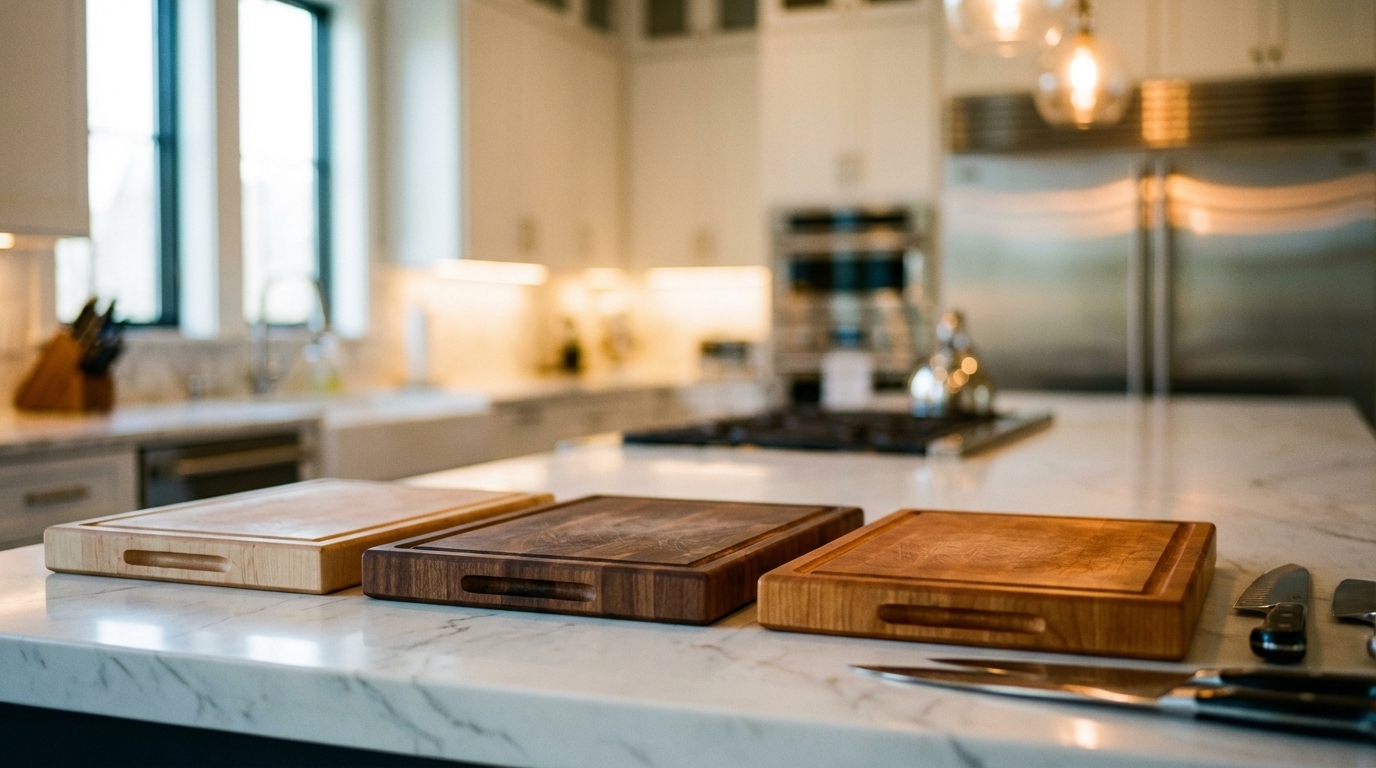
Maple, Walnut, or Cherry? Picking the Right Board Wood
About Misen
We make kitchen tools that work better, last longer, and cost less than you’d expect: everyday innovations with a radical focus on our customers’ actual need.
Table of Contents
Summary
Choosing a cutting board isn't just about looks--it's about hardness that won't dull knives or harbor bacteria, grain that closes up after cuts, and upkeep that fits your kitchen rhythm. This guide walks you through why American maple, walnut, and cherry sit in the Janka sweet spot of 900-1,500 lbf, balancing durability with knife care, while explaining how maple's ultra-tight fibers naturally pull moisture and bacteria away, walnut's juglone adds antimicrobial punch, and cherry's softer surface darkens photogenically but needs more frequent oiling. You'll learn when to invest in end-grain construction--where fibers part instead of sever, extending knife life and self-healing cut marks--and when an edge-grain board's lower cost, lighter weight, and forgiving maintenance make more sense for everyday slicing or serving. The article also demystifies care: food-safe mineral oil, the water-drop test, and a break-in schedule that keeps boards from warping or stinking. By the end, you'll know exactly which wood, construction, and routine will give you a hygienic, long-lasting board that protects both your blades and your food.
Hardness, Grain, and Food Safety
Choose a cutting board in the 900-1,500 lbf Janka sweet-spot--like enzyme-rich, tight-grained maple that pulls moisture and kills bacteria within three hours--so your knives stay sharp and your food stays safe.
Janka hardness range for the best wood for a cutting board
The Janka scale measures wood hardness--essentially how much force it takes to dent the surface. For cutting boards, you want wood between 900 and 1,500 lbf. Too soft?
Your board warps, cracks, and develops grooves where bacteria hide. [1] Too hard? You'll be sharpening your knives constantly.
[2] That's the problem with trendy options like acacia (often over 2,000 lbf) and bamboo--they look great but punish your knife edges. [1] The sweet spot includes three classic American hardwoods that balance durability with knife care, each at a different point on the hardness spectrum (detailed in the next section).
Closed‑grain structure and bacterial resistance
Think of grain structure like a sponge--tighter grain means fewer places for bacteria to hide. Maple leads the pack with its close-knit fibers that naturally resist liquid penetration. But here's what really matters: wood fights back.
When your knife cuts the surface, the fibers don't just sit there damaged--they close up around the cut, pulling moisture away from where bacteria could grow. [4] Research proves this isn't wishful thinking. A University of Illinois study found that properly oiled maple boards actually kill bacteria within three hours thanks to natural enzymes in the wood.
[4] The mineral oil treatment you apply creates a water-repelling barrier that makes liquids bead up instead of soaking in--giving bacteria less time and surface area to work with. [4] If you're regularly prepping raw meat or fish, this natural defense system makes tight-grained woods like maple the practical choice over more open-grained options.
Maple, Walnut, and Cherry: Core Differences
Choose end-grain hard-maple for an indestructible daily prep board whose self-healing cuts stay light-colored so stains can't hide, or pick walnut/cherry only if you crave their evolving amber/chocolate patina and are willing to oil them more often to hide softer wood's scars.
Maple - durability and knife‑friendliness
At ~1,450 lbf, hard maple sits at the top of the practical hardness range--the hardest of the three common American cutting board woods--which makes it the most resistant to visible scarring over time. [5] That durability doesn't come at the cost of your knives.
The key is construction: on an end-grain maple board, the knife enters between wood fibers rather than across them, so cut marks close back up after each oiling session instead of accumulating. [6] Users who've switched from edge-grain to end-grain maple consistently report that surface cuts essentially disappear between uses, which is something harder exotic woods can't offer because they simply don't flex that way.
[6] Maple's neutral, fine grain also resists odor absorption and stays visibly light-colored, so staining is easier to spot and address--a practical advantage over darker boards where contamination can go unnoticed. [7] For cooks who want a single board that handles high-volume daily prep without frequent replacement, maple earns its reputation in professional test kitchens because it absorbs minimal moisture, which limits warping even under heavy use.
Walnut & Cherry - color, softness, and maintenance
Walnut & cherry - color, softness, and maintenanceWalnut and cherry age in opposite directions, which matters more than their starting color. Cherry begins as pale salmon or light pink--freshly cut, it looks almost unremarkable--but exposure to light triggers a photosensitive darkening that deepens it to rich reddish-brown within 6-12 months.
[10] Walnut reverses that pattern: its deep chocolate tones gradually lighten over years, developing silvery and honey undertones that give it a different kind of character than the board you originally bought. [9] Both woods sit near the lower end of the practical hardness range, which translates directly to knife friendliness--less edge abrasion per cut compared to maple--but cherry's slightly lower rating means it shows knife marks more visibly over time and benefits from more frequent conditioning to stay looking clean.
[8] Walnut's medium-open grain actively drinks oil, so it needs treating every 6-12 months to maintain moisture resistance and bring out its depth; when properly oiled, the chocolate grain pops with noticeably more dimension. [9] Where walnut pulls ahead on food safety is chemistry: it contains juglone and related compounds that give it stronger natural antimicrobial properties than cherry, a practical advantage during raw protein prep.
Board Construction: End‑grain vs. Edge‑grain
End-grain boards cost twice as much but let your knives glide between spring-back fibers for fewer sharpening trips, while edge-grain models trade that self-heeding edge care for lighter weight and a sub-$200 price tag.
End‑grain benefits for blade care
The way end-grain boards are built explains everything about why they protect knife edges. In end-grain construction, wood blocks are oriented so the cut ends of the fibers face up--think of a bundle of straws standing upright. When a blade comes down, it slips between the fibers rather than driving across them.
[11] That distinction is what separates end-grain from every other board type: your edge isn't colliding with wood, it's parting it. [12] Edge-grain boards, by contrast, run fibers horizontally, so each cut severs them. Over time, that severing causes chipping, roughness, and deep scarring--the same kind of groove accumulation you'd get from a plastic board.
[11] End-grain avoids this entirely because nothing is being severed; the fibers spring back after each pass, which is also why surface marks close up rather than accumulate between uses. [12] The practical outcome for your knives is less edge abrasion per cut, which means longer intervals between sharpening--a meaningful difference if you're using high-quality blades daily. [13] The tradeoff is cost: the additional labor and material required to orient, cut, and assemble end-grain blocks makes these boards significantly more expensive than edge-grain alternatives, so they're best reserved for primary prep work rather than tasks involving serrated knives or heavy-impact butchering.
Edge‑grain pros, price, and everyday handling
Edge-grain boards earn their place as the default choice for most kitchens by solving the two main complaints about end-grain: weight and cost. Quality edge-grain boards start around $50-$70 and rarely exceed $200, compared to end-grain boards that start near $100 and can run $300-$500 for larger sizes--roughly half the price for a board that handles the same daily prep load.
[14] The simpler construction--wood strips bonded along their long edges rather than cut and reassembled block by block--also means fewer glue joints, which makes edge-grain boards structurally more stable and less susceptible to warping from moisture fluctuations. [14] That same reduced porosity is what makes maintenance more forgiving: where end-grain needs monthly oiling, edge-grain typically needs treating only quarterly under regular use, and it dries faster after washing.
[14] The tradeoff is visible at the surface--because knife cuts run across the wood fibers rather than between them, edge-grain accumulates cut marks over time rather than closing them up, and those grooves eventually need sanding to restore a clean surface. [15] That's a real limitation for high-frequency heavy chopping, but it matters less for the tasks edge-grain actually excels at: moisture-heavy produce, rolling out dough, slicing meat, and serving--uses where the board spends more time on the counter than under a blade.
Care Routine for Long‑Lasting Boards
Grab food-grade mineral oil, oil your new board every other day for its first week, and after that simply sprinkle on water--if it soaks in instead of beading, give the board an overnight oil soak followed a wax topcoat to keep it crack-free and flavor-neutral.
Oil, condition, and frequency
Stick with food-safe mineral oil for your boards--it's the only option that won't go rancid or leave weird flavors behind. Cooking oils like olive or vegetable might seem convenient, but they'll break down and make your board smell funky over time. [16] For a brand new board, show it some extra love: oil it every couple of days for the first week, then weekly for a month. After that initial break-in period, you'll develop a feel for when it needs attention--typically when the surface looks dry or feels rough.
[17] (As we mentioned earlier, end-grain boards will need monthly oiling while edge-grain can go quarterly. ) Here's a simple test: sprinkle a few water drops on the surface. If they bead up, you're good. If they soak in, grab that oil bottle.
[16] The process is straightforward: make sure your board is completely dry first, then work the oil into all surfaces--top, bottom, and edges--with a clean cloth. Let it stand upright overnight to really drink in that moisture before wiping away any excess. [18] Follow up with a food-safe board cream or beeswax conditioner to lock in that protection and keep your board looking fresh between treatments.
Cleaning, sanitizing, and storage tips
Cleaning starts before the water does.
Conclusion
Key Takeaways
- Hardness sweet spot for boards is 900-1,500 Janka; maple at ~1,450 lbf resists scarring yet spares knives.
- End-grain maple hides knife cuts because fibers part then rebound, unlike edge-grain that severs and grooves.
- Walnut's natural juglone compounds give it stronger antimicrobial power than cherry for raw-meat prep.
- Edge-grain boards cost half of end-grain, need oiling only quarterly, but require sanding once grooved.
- Test board dryness with water drops: if they soak in, re-oil; use only food-grade mineral oil to avoid rancidity.
References
- https://www.squaretreelane.com/blogs/the-wood-files/things-you-should-know-before-investing-in-a-cutting-board
- https://shop.mammamangia.com/blogs/cutting-board-guides/best-wood-for-cutting-boards?srsltid=AfmBOooEJYBpnum25PkC4Egf5FsblfWuI7Wf5y1C-t12wtNTDFljLmEF
- https://www.titanedgetitanium.com/blog/best-wood-for-cutting-boards
- https://www.johnboos.com/blog/wood-vs-plastic-choose-a-wood-cutting-board-every-time?srsltid=AfmBOorbvyJuIZqNJ2W39EFICuZRLVOfOTvkUk3iZt9_Fv4ps9koi7-w
- https://theboardsmith.com/blogs/wisdom-behind-the-wood/wisdom-behind-the-wood-7-janka-hardness?srsltid=AfmBOopu_9DFNp1iBbKBUUhXzpDg_LMTmkhXybKE9gBTWHD2dsvV6nwH
- https://www.reddit.com/r/Cuttingboards/comments/1dekmdf/which_wood_is_the_best_balance_between_durability/
- https://www.chopflowboards.club/blog/materials-craftsmanship-history/best-wood-cutting-boards-knife-safe-guide/
- https://virginiaboyskitchens.com/blogs/features/cherry-vs-walnut-cutting-board?srsltid=AfmBOoq7HR5UHKThuMAyYuHlJvxvh5k7nqU9-3GkxEr9yW92EGGaAHeR
- https://oldsaguaro.com/blogs/cactus-chronicles/choosing-your-wood-walnut-cherry-or-maple?srsltid=AfmBOopmQqB90m7xjLiUnGAYRWLny_lKqH0Rm6sycNaACoB_Ctkgq0Qd
- https://butcherblockco.com/hardwood-species-comparison?srsltid=AfmBOor13rElxzsnEjhx40iSt7E3zwGnRmwmA0j6YeKnnSxUBDvGLOP2
- https://theboardsmith.com/blogs/wisdom-behind-the-wood/wisdom-behind-the-wood-8-end-grain-vs-edge-grain?srsltid=AfmBOooHizQrhOTTsYuPd85Tj7QPATnIcEf66sfSLVtqNnh2W5NL4Uwv
- https://www.amishclassiccreations.com/blogs/blog/the-benefits-of-end-grain-cutting-boards?srsltid=AfmBOorQE-ZaC9hUGcwOafZejM8RBG4OD7w665qOopbbIrmW1yZWuUok
- https://www.thecookingguild.com/blogs/news/the-unbreakable-bond-why-your-cutting-board-choice-matters-to-your-knives?srsltid=AfmBOopPdP8rUEFuLJJy-uGoRe5Z2cIOh_57z9WEJdyoRWZu86MCD41V
- https://www.bcknife.com/blogs/news/end-grain-vs-edge-grain-cutting-boards-which-is-be/
- https://sonderla.com/blogs/sonder-la-blog/end-grain-vs-edge-grain-cutting-boards?srsltid=AfmBOooa7xG436p8fWUU7OWDySSflF4fWoP5dqco4lVHRwD1k3Y00jUh
- https://www.seriouseats.com/how-to-season-and-maintain-a-wood-cutting-board
- https://www.nytimes.com/wirecutter/guides/how-to-clean-wood-cutting-boards/
- https://becauseyoucook.com/blog/the-ultimate-guide-how-to-oil-your-cutting-board-like-a-pro/?srsltid=AfmBOopWwX2gSLYGazRT4QFS1yJPZG_WNJmXv7h858PnAPrH0LpIgsE4
- https://www.arnoldwood.com/blog/how-to/sanitize-cutting-boards/