Non-Stick Without the Coating: Borosilicate Glass Against PFAS Frypans
About Misen
We make kitchen tools that work better, last longer, and cost less than you’d expect: everyday innovations with a radical focus on our customers’ actual need.
Table of Contents
Summary
The article "Non-Stick Without the Coating" equips readers to ditch PFAS-laden frypans for good by showing how borosilicate glass delivers the same slip-and-release convenience through physics, not forever-chemicals: you'll learn why traditional PTFE coatings crack above 500 degreesF, shed microplastics, and force a costly, planet-polluting replacement cycle every few years, while thermal-shock-proof glass pans (safe from -40 degreesF to 572 degreesF) stay inert, chip-free, and warranty-backed for decades. It walks through the science of glass's non-porous surface, explains proper pre-heating and oil-use techniques for searing, stir-frying, and freezer-to-oven casseroles, and details simple care that keeps the surface pristine and odor-free for life. By comparing real ownership costs--one $150 glass pan versus repeatedly buying $50 PFAS pans--it proves the switch saves money and eliminates the 2.3 million microplastic particles a scratched coating can release, all while helping home cooks comply with incoming state bans and protect their families from PFAS-linked cholesterol, liver, and developmental risks. Readers walk away knowing exactly how to cook confidently, sustainably, and toxics-free with a material that never needs replacing and is 100 % recyclable, turning the kitchen into the easiest place to start cutting forever chemicals out of daily life.
Understanding PFAS in Traditional Non‑Stick Frypans
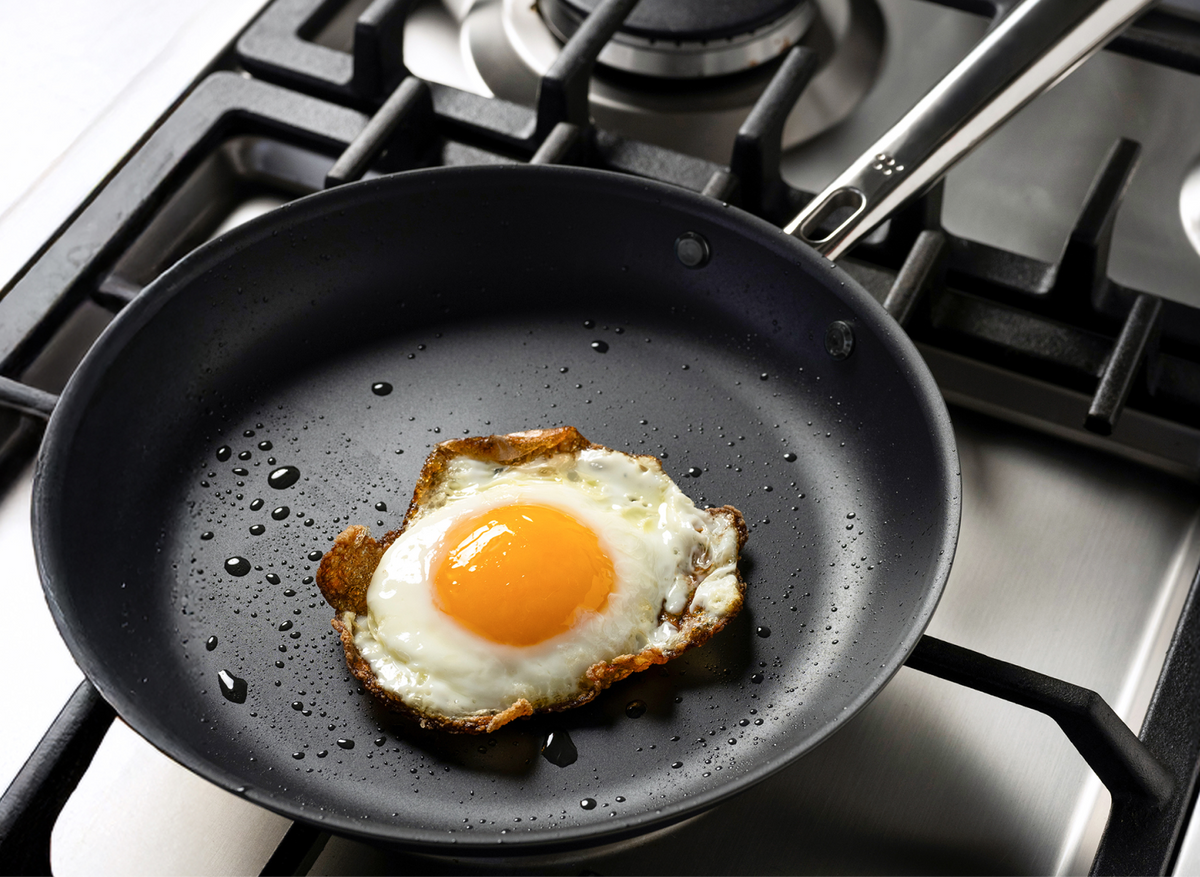
Those convenient non-stick pans that make eggs slide effortlessly have been silently dosing 99.7% of Americans with indestructible PFAS "forever chemicals" that accumulate in your body for life and are linked to cancer, liver damage, and reduced vaccine effectiveness in children.
How PFAS Coatings Work and Why They Matter
Let's talk about what's really in your non-stick pan. Traditional non-stick cookware uses a synthetic coating called polytetrafluoroethylene (PTFE) -- you might know it as Teflon. Picture billions of PFAS molecules bonded together to create that familiar slick surface [2]. These fluorine-carbon bonds form a water-repellent barrier that keeps eggs sliding right off your pan.
Here's where it gets concerning: Until 2015, manufacturers made PTFE using perfluorooctanoic acid (PFOA), a forever chemical that's now in the blood of 99. 7% of Americans [2]. While non-stick coatings transformed cooking with their convenience, they come with serious trade-offs. Heat your pan above 500 degreesF and the coating starts breaking down, releasing toxic fumes that can cause "polymer fume fever" -- basically flu-like symptoms from your cookware [2][3].
Use the wrong utensil or scrub too hard, and you'll see the coating flake off. That means replacing your pans every few years as the surface deteriorates [1]. Even though manufacturers switched from PFOA to alternatives like GenX, these newer chemicals still persist in the environment and raise similar health concerns [2]. It's no wonder home cooks are looking for better options.
Health and Environmental Impact of PFAS
You've probably heard PFAS called "forever chemicals" -- and there's a good reason. Their carbon-fluorine bonds are so strong they resist breaking down for hundreds of years [4][5]. This means they travel through water, soil, and air, building up wherever they go. Once PFAS enter your body, they settle into fatty tissues and stay there. Your body simply can't eliminate them effectively [6].
CDC data shows most Americans already have PFAS in their blood [4], and the health impacts are concerning: higher cholesterol, liver enzyme changes, reduced vaccine effectiveness in kids, and increased risk of kidney or testicular cancer [4]. For pregnant women, PFAS exposure can lead to lower birth weights and increased risk of high blood pressure or pre-eclampsia [4]. Here's what makes studying PFAS tricky -- we're exposed to multiple types at once, along with other environmental chemicals, making it hard to pinpoint exact effects [4]. Children are especially vulnerable since their developing bodies may be more sensitive to these chemicals. They can be exposed through breast milk, formula made with contaminated water, or even in the womb [4].
States are taking action. Minnesota, Connecticut, Maine, Vermont, and Rhode Island have already banned products with intentionally added PFAS, with phase-outs starting between 2025 and 2028 [5]. California's pending legislation would ban PFAS in cookware by 2030 [5]. The message is clear: it's time to find safer alternatives for our kitchens.
Borosilicate Glass vs PFAS Non‑Stick: The Cleaner Choice
Ditch the forever-chemical coatings--borosilicate glass gives you lifelong, high-heat non-stick with nothing but a slick, non-porous surface and a drop of oil.
Why Borosilicate Glass Is Naturally Non‑Stick
Borosilicate glass delivers non-stick performance through simple physics rather than synthetic chemicals. While PFAS-coated pans rely on chemical coatings that break down and flake into your food, glass gets its food-release properties naturally. The secret? Glass cookware has a completely non-porous surface that won't absorb food particles or oils [7]. Nothing sticks, nothing stains, and nothing leaches into your meals--it's truly inert [7].
Here's what makes glass different: those PFAS pans you're replacing every few years? Glass maintains its properties indefinitely [7]. If you're looking to eliminate "forever chemicals" from your kitchen, glass offers a transparent solution--literally. You can see exactly what you're cooking with, and it's nothing but glass. The non-porous surface means proper preheating and a bit of oil creates an effective non-stick cooking experience.
No chemicals needed, just good technique. That's the kind of straightforward cooking we believe in. When you understand how your cookware works, you can make it work better for you.
Thermal‑Shock Resistance and Everyday Durability
Let's talk durability. Quality borosilicate glass handles temperature swings that would destroy other cookware--we're talking -40 degreesF to 572 degreesF without breaking a sweat [9]. That means you can prep a casserole, freeze it for later, and pop it straight into the oven (with a little temperature adjustment time, of course). Borosilicate glass resists thermal shock better than regular glass [9]. But here's the real advantage: that non-porous surface never changes.
It won't absorb foods, harbor bacteria, or deteriorate like those PFAS coatings that scratch and flake after a few years [9]. Glass cookware you buy today will perform exactly the same way decades from now. The key to longevity? Respect the temperature changes. Let hot glass cool gradually, and give cold glass time to warm up.
It's not high-maintenance--just common sense. Treat it right, and you'll never need to replace it because the coating wore out. There is no coating. Just solid, dependable glass that works as hard as you do in the kitchen.
Practical Cooking with Borosilicate Glass
Preheat your borosilicate glass pan thoroughly, move it confidently from freezer to oven, and enjoy flawless sears, stir-fries, and casseroles that taste purely of your food--then simply wash with soap for a pan that outlasts coated ones without staining or lingering odors.
Techniques for Searing, Stir‑Frying, and Baking
Ready to actually cook with glass? Here's what you need to know. For searing, preheat your glass pan thoroughly before adding oil--patience is key since glass heats more gradually than metal. Once hot, add a thin layer of oil and wait for it to shimmer before adding your protein [10].
Stir-frying works great too. Just use a bit more oil than you might with coated pans, and make sure everything's properly preheated before tossing in your ingredients. The smooth surface keeps flavors pure--no chemical taste, just your food [10]. Glass really shines for baking and roasting.
As we mentioned earlier, its thermal shock resistance means you can move from freezer to oven safely. Perfect for make-ahead casseroles or when you need a pan that goes from stovetop to oven without missing a beat [10]. Unlike coated pans that can't handle high heat, glass stays strong through extended roasting sessions. Just remember to let it adjust gradually between temperature extremes--no hot glass on cold counters or cold water on hot pans [10].
Cleaning and Maintenance to Extend Pan Life
Keeping your glass cookware in top shape is refreshingly simple. After cooking, let it cool down naturally--thermal shock is glass's only real enemy. Once cooled, wash with regular dish soap and a soft sponge. No special cleaners needed, no delicate coatings to baby [11].
Storage matters too. Stack carefully with padding between pieces, or better yet, give each piece its own space. Check regularly for chips or cracks--if you spot any, it's time to retire that piece [11][12]. Here's the beautiful thing: unlike those coated pans that wear out no matter how careful you are, glass just keeps going.
That smooth surface won't stain or hold onto last night's garlic smell. Even after cooking tomato sauce or curry, a simple wash brings it back to pristine condition [11]. No wonder professional kitchens love glass--it delivers consistent results year after year without the drama of deteriorating coatings.
Cost‑Effective and Sustainable Kitchen Solutions
A $150 borosilicate glass pan backed by a 10-year--or even lifetime--warranty will outlast and ultimately cost you less than repeatedly replacing $50 PTFE pans every few years, while also keeping non-stick cookware out of landfills.
Long‑Term Cost Comparison: Glass vs Coated Pans
Borosilicate glass cookware offers substantial long-term savings despite higher upfront costs compared to PFAS-coated alternatives. While ceramic-coated non-stick pans like Caraway ($445) and Quince ($200) present moderate initial investments [13], their primary financial advantage comes from durability. Traditional PTFE-coated pans require replacement every few years as their synthetic surfaces deteriorate regardless of maintenance level [14].
In contrast, properly maintained borosilicate glass cookware remains serviceable for decades without degradation of its non-stick properties [15]. This extended lifespan eliminates the recurring replacement costs that PFAS pan owners face. Quality glass bakeware manufacturers often back their products with significant warranties--Xtrema offers 10-year coverage, while Made In provides lifetime warranties on their products [15].
When calculating total ownership costs over a 10-year period, a $150 borosilicate glass pan that lasts the entire decade proves more economical than replacing a $50 PTFE-coated pan three or four times during the same timeframe. The durability factor becomes especially significant in busy households where cookware undergoes frequent use and cleaning cycles. Beyond direct financial savings, glass cookware eliminates the environmental costs of repeatedly manufacturing, shipping, and disposing of deteriorated non-stick pans, providing both economic and ecological advantages over conventional non-stick options.
Reducing Waste with Durable, PFAS‑Free Cookware
Borosilicate glass cookware reduces kitchen waste by eliminating the replacement cycle that traditional non-stick pans require. Most non-stick pans must be discarded after just a few years when their coatings degrade, or immediately if scratched, continuously adding to landfills [1]. Their short lifespan creates a perpetual consumption cycle that borosilicate glass breaks by offering decades of service without degradation. Beyond individual waste reduction, choosing borosilicate cookware addresses larger environmental concerns--79% of non-stick pans contain PTFE coatings that release up to 2,300,000 microplastics when damaged, creating persistent pollutants [17].
Borosilicate glass offers a sustainable alternative as a 100% recyclable material [17]. When it eventually reaches end-of-life, it can be fully reprocessed without contributing to landfill waste, closing the materials loop that remains open with conventional non-stick cookware. This sustainability extends beyond the product itself--eliminating the energy, resources, and packaging required for frequent replacements reduces your kitchen's overall environmental footprint [16]. The durability advantage becomes especially significant considering 65% of surveyed consumers express concern about PFAS chemicals in their cookware [1].
By choosing materials that maintain integrity without synthetic coatings, consumers effectively reduce both chemical exposure and physical waste. Practical strategies for waste reduction include replacing your most frequently used cookware first, transitioning gradually as budget allows, and properly recycling old pans when possible [16]. This shift toward durable, non-toxic cookware represents a small but meaningful step in creating a more sustainable kitchen ecosystem.
Conclusion
Key Takeaways
- 99.7% of Americans have PFAS 'forever chemicals' in their blood from non-stick pans.
- Borosilicate glass cookware offers natural non-stick without any synthetic coatings.
- Glass pans last decades while PFAS coatings degrade and must be replaced every few years.
- PFAS exposure is linked to cancer, lower birth weights, and reduced vaccine effectiveness.
- Borosilicate glass handles -40 degreesF to 572 degreesF and won't leach chemicals into food.
- Damaged non-stick pans release up to 2.3 million microplastics into the environment.
- States are banning PFAS in cookware between 2025-2030, pushing safer alternatives.
References
- https://www.consumerreports.org/home-garden/cookware/best-frying-pans-if-you-want-to-avoid-pfas-chemicals-a1006253549/
- https://www.nrdc.org/stories/why-nonstick-pans-are-hot-mess
- https://www.perkinelmer.com/library/atl-pfas-in-your-pan.html
- https://www.epa.gov/pfas/our-current-understanding-human-health-and-environmental-risks-pfas
- https://www.nbcnews.com/select/shopping/best-nonstick-cookware-alternatives-rcna233182
- https://pmc.ncbi.nlm.nih.gov/articles/PMC11901761/
- https://www.implasticfree.com/non-toxic-cookware-brands/
- https://www.cookut.com/en/blog/frying-pans-pfas-how-to-avoid-chemicals-and-cook-safely-
- https://malacasa.com/blogs/news/safest-non-toxic-bakeware-materials?srsltid=AfmBOoqp8yqYQgfRUGqBK3jpvb82Syxcv4QnB938hc1Wf7lxrtFf3CBd
- https://eatbeautiful.net/borosilicate-glass-cookware-the-best-pot-youre-not-using-yet/
- https://www.safecoze.com/blog/high-borosilicate-glassware-durability/
- https://www.ultident.com/blog/post/how-to-maintain-your-borosilicate-laboratory-equipment-for-longevity
- https://www.foodandwine.com/lifestyle/kitchen/best-non-toxic-cookware
- https://www.consumerreports.org/toxic-chemicals-substances/you-cant-always-trust-claims-on-non-toxic-cookware-a4849321487/
- https://www.leafscore.com/eco-friendly-kitchen-products/the-best-non-toxic-bakeware/
- https://www.consumerreports.org/home-garden/opt-for-safer-kitchenware-a2506781798/
- https://www.safecoze.com/blog/switch-to-non-toxic-borosilicate-cookware/