Thermal Shock Safe? How Borosilicate Glass Protects Flavor and Health
About Misen
We make kitchen tools that work better, last longer, and cost less than you’d expect: everyday innovations with a radical focus on our customers’ actual need.
Table of Contents
Summary
Borosilicate glass cookware stands out as a kitchen hero because its low thermal expansion coefficient lets it glide through extreme temperature swings--from freezer to oven--without cracking, protecting both your dinner and your hands from dangerous thermal-shock failures. By remaining chemically inert, it never leaches metals, microplastics, or off-odors into food, so the flavors you carefully layer stay pure and your long-term exposure to questionable compounds drops to zero. The article walks you through the science behind that thermal resilience, contrasts it with soda-lime or non-stick alternatives, and offers simple care tips--cool-down periods, gentle utensils, smart storage--that keep the glass flawless for decades. Readers will come away confident that investing in borosilicate means safer meals, truer tastes, and one less kitchen item destined for the landfill, all while answering the central question with a resounding yes, this material is as safe for your health as it is loyal to your palate.
Understanding Thermal Shock and Borosilicate Glass
Boron atoms in borosilicate glass vibrate far less than those in ordinary glass, cutting its expansion rate to one-third that of soda-lime and letting it survive 330 degreesF temperature swings--like going straight from fridge to oven--without the hidden micro-cracks that can shatter standard kitchenware days later.
What is thermal shock and why it matters
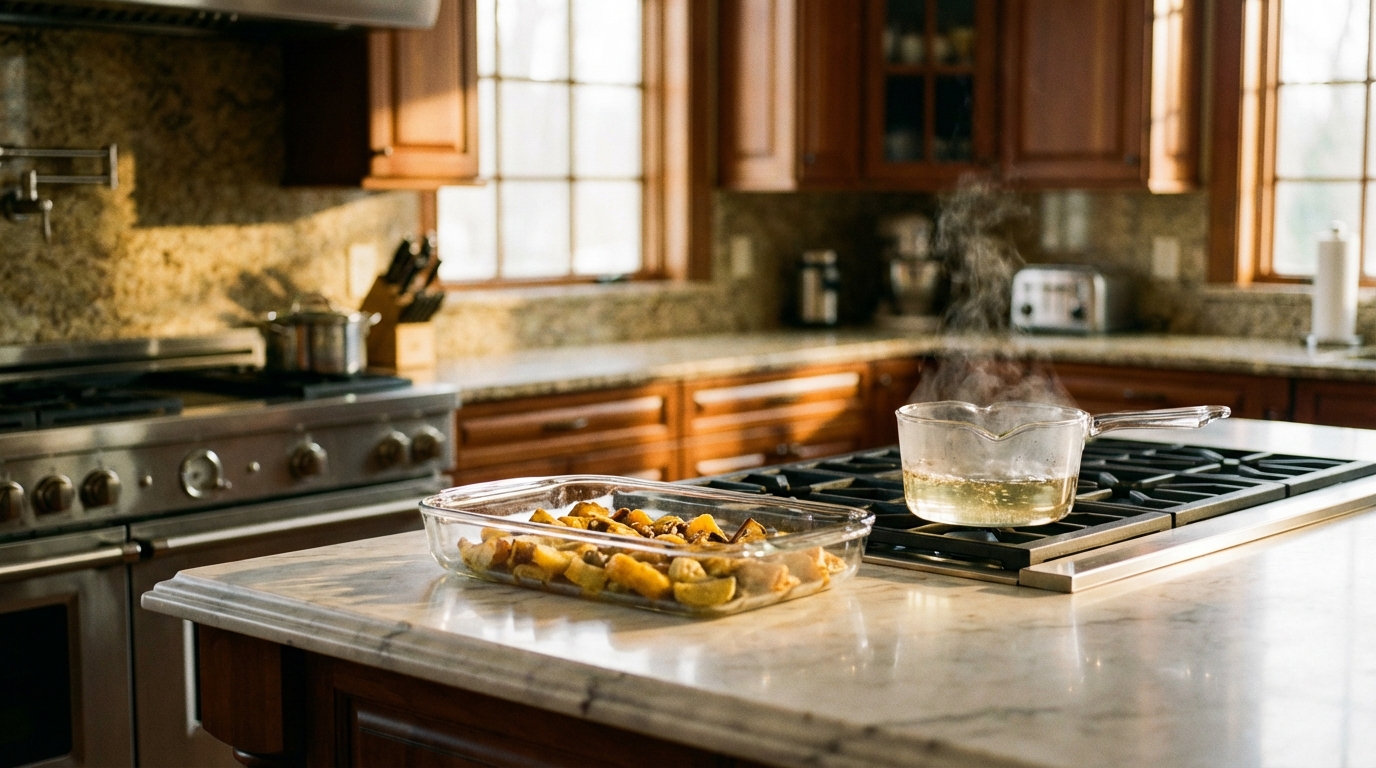
Glass expands when heated and contracts when cooled. Thermal shock happens when this process occurs unevenly -- one part of the glass changes temperature faster than the rest, creating internal stress that can crack or shatter it without warning. [1] The stress concentrates at the boundary between the hotter and cooler zones, where the material is literally being pulled in opposite directions at once. [2] This is a real and common kitchen hazard. Pouring boiling water into a cold glass, pulling a chilled ceramic dish straight from the fridge into a hot oven, or rinsing a hot pan under cold tap water all trigger the same mechanism -- rapid, uneven temperature change that the material can't absorb fast enough. [3] The risk matters because breakage isn't always predictable: a piece of glass can survive a thermal event but develop invisible micro-cracks that cause it to fail days or weeks later under far less stress. [2]
How borosilicate glass resists rapid temperature changes
Borosilicate glass handles thermal shock better than ordinary glass because of one key physical property: its coefficient of thermal expansion (CTE) -- the rate at which a material grows or shrinks as temperature changes. Borosilicate's CTE sits at roughly 3 x 10⁻⁶ per Kelvin, about one-third that of standard soda-lime glass. [4] The reason comes down to boron itself: boron atoms vibrate far less than the elements used in conventional glass, so the entire structure expands and contracts less dramatically when temperatures shift. [5] That reduced movement means less internal stress builds up across the glass when one part heats or cools faster than another -- which is exactly the mechanism that causes breakage. In practical terms, borosilicate can survive a temperature differential of around 330 degreesF (166 degreesC) before fracturing, while typical soda-lime glass -- the kind in most standard kitchenware -- cracks at differentials as low as 100 degreesF (40 degreesC). [4] That gap explains why a borosilicate dish can go from refrigerator to oven without incident, where an ordinary glass vessel would fail under the same conditions.
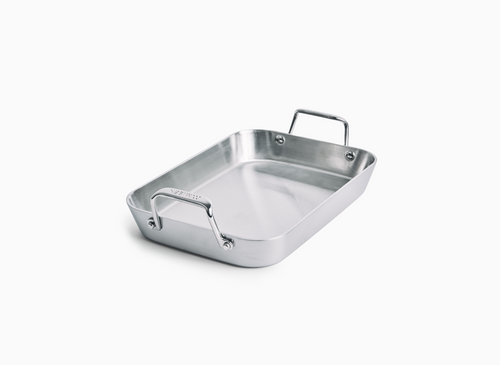
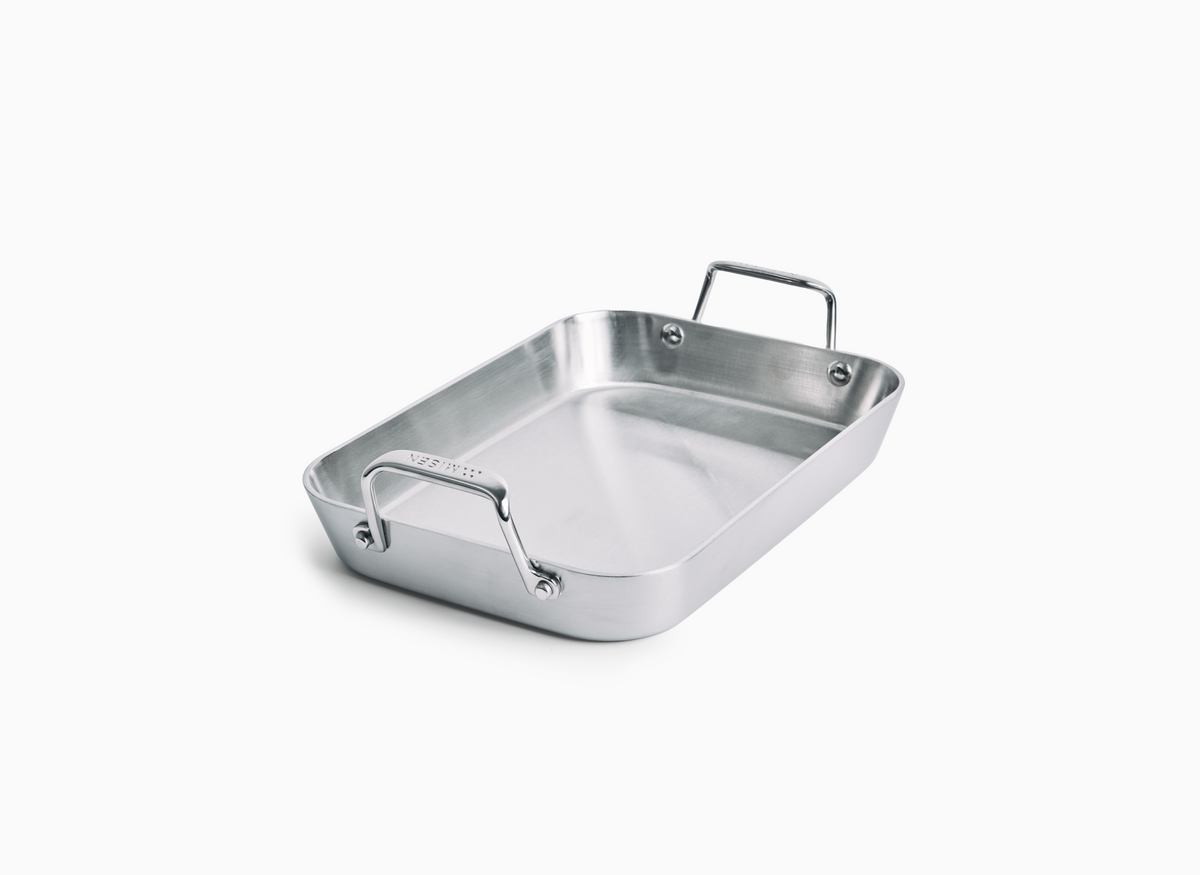
If you're looking for cookware that handles temperature extremes, this durability extends beyond glass -- our roasting pan delivers the same worry-free transitions from fridge to high heat.
Safety Benefits for Your Health and Food Flavor
Borosilicate glass keeps your meals free of BPA, lead, and microplastics while letting the true flavors shine through, dish after dish.
Non‑toxic composition and health implications
Borosilicate glass's safety starts with what it's made of. Its core ingredients -- silica, boron trioxide, soda ash, and alumina -- are stable, naturally occurring materials that, once fused at high temperatures, form a chemically inert structure free of BPA, phthalates, lead, and cadmium. [4] These are the compounds most associated with chemical migration in food containers, particularly in plastics that break down under repeated heating. Because borosilicate is also non-porous, it won't absorb food odors, flavors, or stains, and it won't leach anything into acidic or oily foods even at high temperatures. [6] The real-world test of this stability is the pharmaceutical industry's use of borosilicate for injectable drug packaging -- classified as USP/EP Type I glass -- where any ion migration from container to solution would be medically unacceptable. [4] If it meets that bar, kitchen use is straightforward.
Flavor preservation compared to metal cookware
Metal cookware introduces a variable that glass simply doesn't: reactivity. Aluminum and reactive metals interact with acidic ingredients -- tomatoes, citrus, vinegar -- altering both flavor and, in some cases, color. Non-stick coatings sidestep reactivity but create a different problem: degraded PTFE coatings can shed up to 2,300,000 microplastics into food, according to research published in *Science of The Total Environment*. [7] Borosilicate glass avoids both failure modes. Its non-reactive surface neither bonds with food compounds nor harbors residual flavors between uses -- meaning a dish cooked in it on Monday doesn't ghost into Tuesday's meal. [7] There's also an even-heating advantage: unlike metal, which concentrates heat at the base and along contact points, glass distributes heat across the entire vessel, reducing scorching and hot spots that can char food edges while leaving centers undercooked. [8] The result is that what you taste reflects the ingredients, not the container.
Practical Care and Everyday Use
A few seconds of gentle rinses, microfiber drying, cooling pauses, and quick finger-tip checks can keep your borosilicate pieces chip-free and cloud-free for decades of safe, money-saving use.
Cleaning, handling, and longevity tips
Borosilicate glass is durable, but simple care habits help it last. To prevent clouding from hard water spots, rinse with distilled water or wipe down with diluted white vinegar -- both work without harsh chemicals. [9] For drying, stick with microfiber cloths.
They prevent water spots and won't scratch the surface like paper towels can. [9] Give hot glass a minute to cool before rinsing. Yes, borosilicate handles temperature changes better than regular glass, but constantly shocking it with extreme swings will shorten its life. [10] Store pieces with space between them -- glass-on-glass contact leads to chips, and even small chips weaken the entire piece. [9] Get in the habit of checking for damage before each use.
Run your finger along the rim and look for hairline cracks. A damaged piece might work fine today but fail tomorrow when heated. [10] These quick checks take seconds and prevent accidents.
Affordability and sustainability of borosilicate cookware
Borosilicate costs more than regular glass or plastic, but it pays off. Because it resists thermal shock, chemicals, and wear, you replace it less often -- saving money long-term. [11] Quality cookware, whether it's borosilicate bakeware or a well-made Answering the Key Question: is borosilicate glass cookware safe?
Scientific evidence and certifications
The certifications attached to borosilicate glass reflect structured, repeatable testing -- not marketing language. High-quality borosilicate must pass FDA, LFGB (Germany's Federal Food and Feed Code), and DGCCRF (France's consumer protection authority) requirements, each involving prolonged leaching tests in acidic solutions designed to simulate real food contact conditions. [13] Under acetic acid exposure intended to replicate worst-case contact scenarios, compliant borosilicate produces zero detectable migration of harmful compounds. [13] The FDA has simultaneously issued active warnings about aluminum, brass, and aluminum alloy cookware that leach measurable lead into food under equivalent test conditions -- there is no known safe level of lead exposure, and the agency has flagged these materials as a direct public health concern. [14] The contrast makes the certification outcome concrete: the same testing methodology that clears borosilicate is the one that fails other common cookware materials.The scientific underpinning is quantifiable rather than qualitative. Borosilicate's resistance to acidic and alkaline environments is ten times greater than soda-lime glass, a figure derived from standardized chemical durability testing rather than manufacturer claims. [15] Ion-exchange-treated borosilicate vials evaluated under pharmaceutical safety frameworks -- among the most rigorous available -- showed enhanced mechanical strength with no cracks detected during stress testing, confirming that the material's performance holds at the outer edge of what safety evaluation demands. [15] Regulatory bodies across three continents arriving at the same approval outcome is less a coincidence than a reflection of what consistent material testing produces when the glass is formulated correctly.
Real‑world cooking scenarios and user confidence
The CPSC data puts breakage risk in useful perspective. Between 2011 and 2020, across all glass bakeware brands, the agency recorded 950 ER-related incidents -- fewer than 10 per month across the entire United States. [8] Most of those incidents involved tempered soda-lime glass used improperly: placing a dish under a broiler, adding cold liquid to a hot pan, or setting a hot dish on a wet countertop. [8] Borosilicate bakeware, by contrast, handles the transitions most home cooks actually encounter -- refrigerator to oven, oven to a dry countertop -- without issue. OXO's borosilicate bakeware line explicitly states it can move from freezer to oven without thawing first, which is the kind of scenario that would reliably destroy tempered soda-lime cookware. [8] When borosilicate does fail under extreme stress, it tends to crack rather than shatter violently, which means less scatter and lower injury risk than a sudden tempered-glass failure. [8]The one scenario where borosilicate's thermal tolerance doesn't translate is direct stovetop use -- unless the vessel is specifically engineered for it.
A standard borosilicate baking dish isn't designed to sit over an open flame; the heat concentrates at the base rather than distributing across the surface, creating exactly the kind of uneven thermal gradient that causes fracture. [16] Glass pots built for direct heat, like those from Trendglas JENA, are manufactured with more even wall thickness and different design tolerances than bakeware -- and even those come with instructions to heat gradually and avoid setting a hot pot on a cold or damp surface. [16] The underlying rule is consistent: the material performs well when used within its design parameters, and following manufacturer instructions isn't a formality -- it's what the CPSC incident data shows separates uneventful use from the rare cases that go wrong. [8]
Key Takeaways
- Borosilicate glass resists thermal shock, so it won't crack from sudden temperature swings.
- It leaches no metals or toxins into food, preserving both flavor and safety.
- Unlike plastic or metal, it won't absorb odors, stains, or acidic residues.
- Safe for oven, microwave, freezer, and dishwasher without degrading.
- Sudden dry heat or cold water on hot glass can still break it--avoid extreme contrasts.
References
- https://labchoiceaustralia.com.au/thermal-shock-explained-simple-rules-to-prevent-glass-breakage-in-daily-lab-work/?srsltid=AfmBOor558yjdntUr9Bk6x1ebEGwYEwfFdsZzvQvDunPmOE0e2MnAFLY
- https://www.nytimes.com/wirecutter/blog/tempered-vs-borosilicate-glass/
- https://www.skottsberg.com/en/knowledge-center/information/thermal-shock/
- https://en.wikipedia.org/wiki/Borosilicate_glass
- https://www.corning.com/worldwide/en/innovation/materials-science/glass/periodic-table-elements/boron.html
- https://slyprc.com/what-is-borosilicate-glass-made-of-why-safer-food-contact/
- https://www.safecoze.com/blog/switch-to-non-toxic-borosilicate-cookware/
- https://blogs.extension.iastate.edu/answerline/2019/03/04/glass-kitchenware-cautions/
- https://www.lenox.com/blogs/buying-guide/how-to-clean-glassware
- https://www.ultident.com/blog/post/how-to-maintain-your-borosilicate-laboratory-equipment-for-longevity
- https://www.safecoze.com/blog/long-term-financial-advantage-glassware/
- https://slyprc.com/soda-lime-vs-borosilicate-glass-guide/
- https://www.fda.gov/food/alerts-advisories-safety-information/fda-issues-warning-about-imported-cookware-may-leach-lead-august-2025
- https://www.safecoze.com/blog/fda-approved-borosilicate-glass-importance/
- https://cooking.stackexchange.com/questions/103723/is-a-borosilicate-glass-pot-safe-to-use-on-a-gas-burner-stovetop