Skip to content
Your cart

Your cart is empty. Let's fix that!

Search

5.5 inch Nakiri Knife - ACUTO440 - New

Nakiri Japanese Vegetable Knife

Regular price
Regular price
$89
Color Blue
  • 60-Day Test Drive

    60-Day Test Drive

  • Lifetime Warranty Against Defects

    Lifetime Warranty Against Defects

  • Free Returns

    Free Returns

Nakiri Knife Description

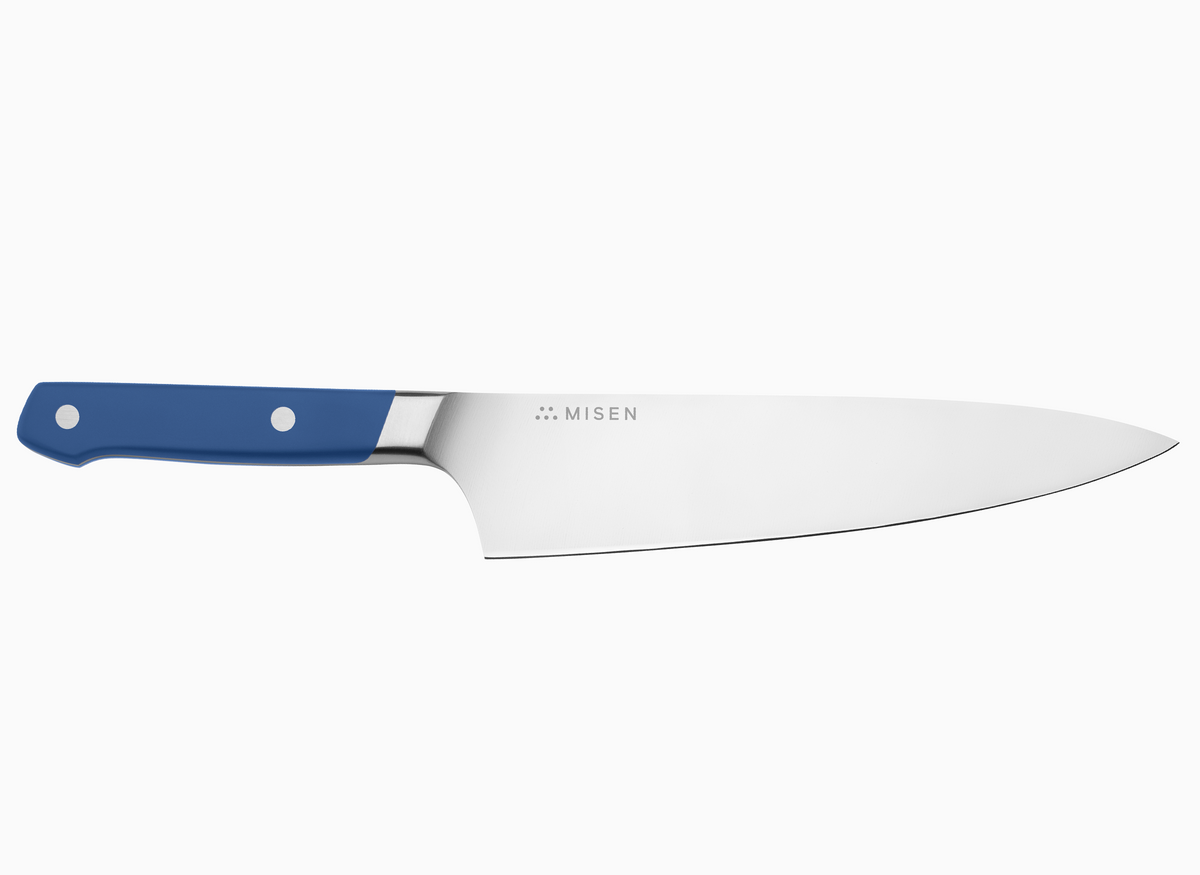
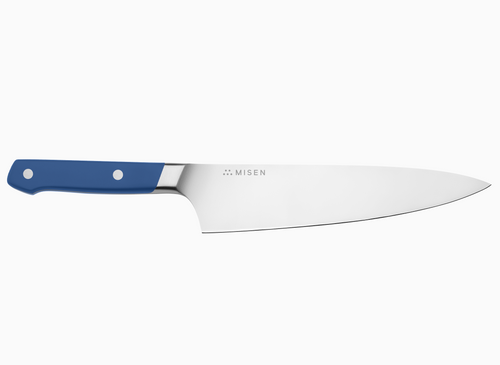
If your cutting board is basically a veggie catwalk, this might be your new favorite knife. The Nakiri is lightweight, nimble, and shaped to make veggie prep (and plenty of other tasks) fast and fun. The Nakiri’s straight blade evenly chops onions, potatoes, and greens, while its gently curved tip lets you rock-chop when the mood (or the recipe) strikes. And of course it’s made from rust-proof AICHI ACUTO440 steel, so it stays sharp with near-zero fuss.

Why the Nakiri Knife is Great

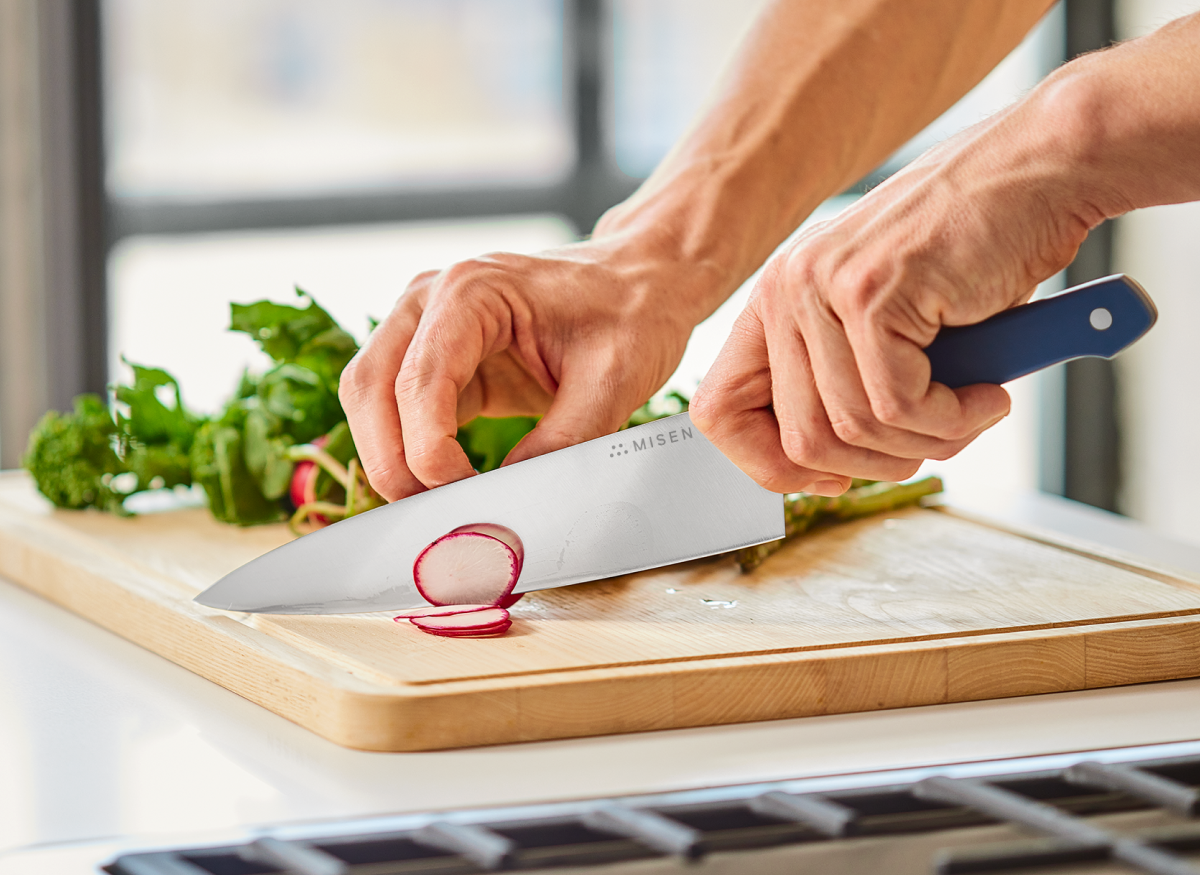
  • Made for veg-heads: The straight blade makes consistent contact with the cutting board for cleaner, quicker chopping, paper-thin slices, and matchsticks.
  • More compact than a chef’s knife: At 5.5”, it’s lighter and easier to control (small-handed folks, we see you).
  • Versatile: Straight blade for quick, up-and-down chopping, plus a gently curved tip that lets you rock-chop too. Then use the blade’s wide surface to scoop those veggies straight into your pan!
  • Groundbreaking AICHI ACUTO440 steel: Rust-proof, high-carbon Japanese steel with excellent edge retention—so it stays sharper longer and needs zero special care.
  • Built for everyday: Fast, comfortable, and satisfying for the kind of cooking you do every day: weeknight stir-fries, salad prep, big-batch Sundays, and everything in between.

Note: The Nakiri may resemble a mini cleaver, but it’s not meant for bones or heavy breakdown! For those jobs, reach for our Boning Knife. For super-precise tip work, reach for a Bunka.

Use, Care, and Warranty - Nakiri Knife

Blade Length: 5.5 in. / 139.7 mm
Total Length: 10.43 in. / 265 mm
Weight: 0.34 lb / 155 g
HRC: 57 / 59
Grind & Edge: 50/50 Symmetrical Grind at 14 Degrees per side
Steel: AICHI ACUTO 440 (Japan)
Country of Production: PRC

Nakiri Knife Specs

  • Hand wash and dry immediately after use
  • Rust-proof up to 50 days submerged in water; lab-tested to withstand up to 50 dishwasher cycles without rusting.
  • Note: High-carbon knives can experience some discoloration and/or staining with prolonged exposure to acidic foods and/or salt. This is purely cosmetic and is not the same as rust.
  • Visit our Use & Care page for more care instructions

Let Us Handle the Sharpening

  • Mail-In Knife Sharpening (on any knife): Free shipping, starting at $11 per knife.
  • We recommend sharpening your knives every 4-6 months.

All Misen Knife products come with a lifetime warranty against defects. For all products, we will replace any defective knives. Learn more about our warranty policy here and what's covered.

How Misen ACUTO440 Knives Stack Up

A comparison chart for knife steel types, including Misen Knives 2.0 (AICHI ACUTO440), Misen Knives 1.0 (AUS10), German Steel (X50CrMoV15), Japanese Steel high-end (VG10), Japanese Steel mid-priced (SUS1A), and Budget Steel (420 SS). It compares maintenance level, rust-proof qualities, sharpening frequency, high durability, and price. Misen Knives 2.0 has low maintenance, is rust-proof, needs sharpening every 4-6 months, is highly durable, and costs $$.

Frequently Asked Questions

What are Misen’s ACUTO440 Knives made of?

Our ACUTO440 Knives are made with AICHI ACUTO440, an exceptionally corrosion-resistant Japanese high-carbon stainless steel. AICHI ACUTO440 is rust-proof, incredibly durable, and has excellent edge retention. What that means for you: less time cleaning and sharpening, more cooking.

What’s the difference between Misen’s ACUTO440 Knives and classic knives?

All of our knives are made from high-carbon stainless steel, which is what gives them their razor-sharpness and excellent edge retention. However, our ACUTO440 Knives have a much higher chromium content (about 18%), which makes them significantly more corrosion (aka rust) resistant.

Our ACUTO440 Knives also feature a rounded spine and heel (the back of the knife where the blade meets the bolster), creating a more comfortable grip over long prep sessions.

How are Misen’s ACUTO440 Knives different from other high-carbon knives?

We wanted our ACUTO440 Knives to be high-performance tools that you could still leave in the sink overnight if you needed to. That’s why our ACUTO440 Knives are made with AICHI ACUTO440, a Japanese high-carbon stainless steel that is more durable and easier to care for than other high-carbon knives, which are prone to rusting and/or chipping without proper care.

What do you mean by rust-proof?

Our ACUTO440 Knives are made with AICHI ACUTO440 steel, an exceptionally corrosion-resistant Japanese high-carbon stainless steel. Our knives have been lab-certified to withstand up to 50 dishwasher cycles, as well as 50 days of being submerged in water, without showing any signs of rust.

Can I put Misen’s ACUTO440 Knives in the dishwasher?

While our ACUTO440 Knives have been lab-certified to withstand up to 50 dishwasher cycles without showing any signs of rust, we generally recommend hand washing all of your Misen knives. Because our knives are extremely sharp, when they get jostled around in the dishwasher, the blade can cut through the soft materials that make up your dishwasher racks. Dishwashing can also damage your knives if the blade edge bangs against hard objects like flatware or pots and pans during the washing cycle.

How often should I sharpen my knives?

Whenever you start to notice your knife is slicing and dicing a little less crisply than usual, it’s time to sharpen. Although our ACUTO440 Knives can go long periods between sharpenings, we generally recommend getting them sharpened about twice a year for best performance. We also recommend regularly using a honing rod between sharpenings to keep your knife edge in good shape.

My blade has discoloration and/or staining. What is this?

While our ACUTO440 Knives are rust-proof, all high-carbon knives can experience some discoloration and/or staining with prolonged exposure to acidic foods and/or salt. This is purely cosmetic and is not the same as rust.