Coated vs. Solid Ceramic: Spotting the Truly Non-Toxic Difference
About Misen
We make kitchen tools that work better, last longer, and cost less than you’d expect: everyday innovations with a radical focus on our customers’ actual need.
Table of Contents
Summary
The article demystifies the cookware aisle by explaining that "ceramic" can mean either a thin, sol-gel coating on metal that eventually wears off or a vessel that is 100% kiln-fired ceramic from handle to rim, and it shows readers how to spot the difference with simple tests like the weight check, rim scratch, and magnet test so they can avoid the hidden metals and petro-based binders that leach into food once the coating breaks down. It details why solid ceramic cookware is inherently non-toxic--no PTFE, PFOA, nickel, or chromium--while even the best ceramic-coated pans carry a short lifespan and potential heavy-metal exposure, and it backs this up with performance data: solid ceramic sears and browns like cast iron, survives oven and dishwasher cycles for decades, and saves energy through lower-heat cooking, whereas coated pans lose their non-stick magic within one to three years and end up in landfills. The piece also explores the sustainability angle, noting that solid ceramic is made from abundant natural minerals, ships with zero plastic if bought from ethical brands, and can be returned to earth as inert aggregate, making it the only choice for cooks who want a forever pan that is as gentle on the planet as it is on their family's health.
Understanding Ceramic Cookware Types
Before you trust that "ceramic" pan, know it's a low-temp sol-gel coating that can degrade into mystery chemicals, whereas solid, high-fired ceramic cookware is pure mineral through and through--no toxins, no flaking, just safe, steady heat.
What defines a ceramic coating?
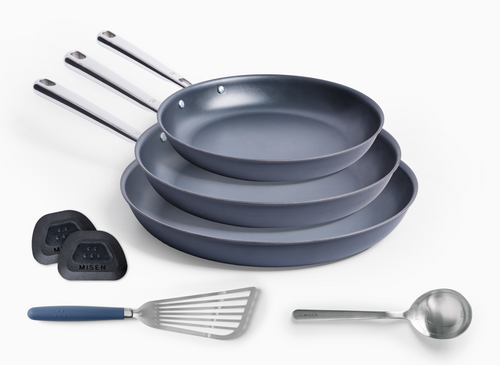
Here's something most cookware brands won't tell you: those "ceramic" pans in your kitchen probably contain no actual ceramic. Instead, they're coated with sol-gel -- a mixture of silica, metal oxides, and binders sprayed onto metal pans and cured at just 400 degreesF to 800 degreesF. [2] To put that in perspective, true ceramics fire above 2,000 degreesF. This low-temperature processing creates an immediate problem: the coating can't handle the heat levels many recipes require. [1] The nonstick surface? That's not ceramic either -- it's sol-gel chemistry creating a slick layer that starts degrading the moment you use metal utensils, crank up the heat, or scrub too hard. [1] Since manufacturers keep their sol-gel formulas proprietary, you'll never know exactly what chemicals you're cooking with -- or what gets released as that coating wears down over months of daily use. [2] For anyone seeking genuinely non-toxic cookware, understanding this distinction between marketing claims and material reality becomes essential.
What makes solid ceramic truly non‑toxic?
Solid ceramic takes a completely different approach: just natural minerals, clay, and water -- no metals, glues, or polymers hiding beneath the surface. [4] That high-temperature firing above 2,000 degreesF (as discussed in the health implications section) transforms these simple ingredients into a dense, non-porous cooking surface that works without any synthetic chemistry. The real difference shows up in your kitchen: while coated pans have a surface layer that can flake or decompose, solid ceramic is the same material throughout. Nothing to chip off into your pasta sauce, nothing to break down when you sear a steak. Some pure ceramic cookware even carries FDA approval and meets California Prop 65 standards -- that's certification against more than 800 problematic compounds, including the usual suspects like lead, cadmium, PTFE, and PFOA. [4] For cooks who want to focus on their food instead of their cookware's chemical composition, that peace of mind matters.
Health Implications of Non‑Toxic Ceramic Coated Cookware
Because a ceramic coating that tests "safe" today can shed titanium-dioxide nanoparticles and hidden PFAS into tomorrow's dinner as it ages, daily cooks who want true peace of mind must treat "non-toxic" as a promise that only lasts if they stay below medium heat, skip the metal utensils, and hand-wash every time.
Potential leaching and safety concerns
The safety gap between ceramic-coated and solid ceramic cookware becomes most visible when coatings start to break down. As discussed in the previous section, sol-gel formulas are proprietary -- and when these coatings degrade, organic polymers and metal oxide nanoparticles can migrate into food. [5] Testing has detected high levels of titanium in several popular ceramic-coated brands, pointing to the use of titanium dioxide nanoparticles, which carry different health risks in nanomaterial form than in their bulk ceramic state. [5] Beyond nanoparticles, some ceramic coatings may contain PFAS compounds other than PTFE and PFOA -- the two chemicals most commonly flagged on product labels. Independent testing of 96 different PFAS compounds across multiple nonstick pan types found that PTFE-coated pans labeled "PFOA-free" still contained measurable PFOA, while ceramic-coated pans tested free of all 96 compounds -- though this doesn't account for the thousands of PFAS not yet included in standard testing panels. [5] Lead is a separate but equally serious concern: the FDA has issued active warnings about imported cookware -- primarily aluminum, brass, and aluminum alloy products -- shown to leach lead under normal cooking conditions. [6] There is no safe level of lead exposure, and children face disproportionate risk, with even low-level exposure linked to learning difficulties and behavioral changes. [6] Here's the key point: the risk compounds over time.
A pan that tests clean when new may behave differently after months of use as the coating wears down.
Why non toxic ceramic coated cookware matters for everyday cooking
Why non-toxic ceramic cookware matters for everyday cookingHere's what matters for your everyday cooking: frequency. Most people cook daily, which means any exposure from degrading coatings adds up over time. Those care requirements we'll detail in the next section -- low to medium heat only, silicone or wooden tools, hand-washing -- aren't just maintenance tips. They're cooking constraints that change how you can use your pan.
Want to sear at high heat? Need the dishwasher convenience? Prefer metal utensils? Each becomes a trade-off with ceramic-coated cookware.
Truly non-toxic options like stainless steel pans remove these restrictions entirely. You get even heat distribution without hot spots, and cleanup is straightforward because food doesn't bond to a degrading surface. [7] For pans you'll use hundreds of times a year, that freedom -- no chemical concerns, no special handling, just reliable performance -- makes all the difference.
Performance Comparison: Coated vs. Solid Ceramic
Choose solid ceramic cookware and you'll trade the yearly replacement cycle of ceramic-coated pans for a dishwasher-safe, metal-utensil-proof surface that keeps conducting heat evenly long after the coating on a 400-degree-F-cured pan has cracked and quit.
Heat distribution and durability
The firing temperature gap between solid ceramic and ceramic-coated cookware shapes how each performs over time. Solid ceramic, fired above 2,500 degreesF, produces a dense surface that retains and distributes heat evenly -- no hot spots that require constant repositioning of food during cooking. [8] Ceramic-coated pans conduct heat through their metal substrate, typically aluminum, but the sol-gel layer cured at just 400 degreesF to 800 degreesF begins to degrade above 500 degreesF, narrowing which cooking techniques remain safe and compressing the pan's functional life. [9] Durability follows the same fault line: solid ceramic is glazed, not coated -- the surface bonds permanently to the base during firing, making it resistant to scratches, metal utensils, and acidic ingredients that routinely shorten a coated pan's lifespan. [8] Ceramic-coated pans typically hold up in peak condition for one to three years before nonstick performance drops noticeably, and unlike cast iron, the surface can't be restored once it wears. [9] For high-rotation use across hundreds of meals a year, that durability gap -- not the nonstick performance straight out of the box -- is the more relevant comparison.
Cleaning, maintenance, and lifespan
How you clean a pan is shaped entirely by what it's made of -- and that difference becomes a daily friction point with ceramic-coated cookware. Coated pans require hand-washing to protect the sol-gel layer, can't handle abrasive sponges or aerosol cooking sprays, and demand low-to-medium heat to avoid degrading the surface that makes them functional. [10] Metal utensils scratch the coating, and once scratched, nonstick performance drops and doesn't recover -- there's no way to restore a worn ceramic coating the way you'd re-season cast iron. [11] Independent testing puts peak performance at 12 to 24 months of daily use before noticeable decline, which means for anyone cooking frequently, replacement becomes a recurring cost. [11] Solid ceramic inverts this entirely: it's dishwasher safe, compatible with metal utensils, and stubborn residue comes off with baking soda rather than careful hand-scrubbing. [10] Because the glaze is fired into the piece rather than applied on top of it, there's no surface layer to protect -- which removes the behavioral constraints that define coated pan ownership and extends functional life well beyond years into generations. [10]
Choosing the Right Pan for a Sustainable Kitchen
Pick solid ceramic once and you're done: it outlasts coated pans by decades, slashes landfill waste, and--when you let it cool before washing and skip the spray oils--drops your lifetime cost per sauté to pennies while keeping PFAS out of the planet.
Evaluating cost, durability, and environmental impact
The cost comparison between coated and solid ceramic shifts when you account for replacement cycles rather than sticker price alone. Ceramic-coated pans cost less upfront, but because their peak performance lasts only a few years before noticeable decline -- and a worn coating can't be restored -- replacement becomes a recurring expense. [12] Serious Eats puts it plainly: find a pan that fits your budget *including* eventual replacement costs, because neither ceramic-coated nor traditional nonstick will last more than a few years at best. [13] Solid ceramic carries a higher initial cost but doesn't follow that replacement cycle -- the glaze is fired permanently into the piece, and the cookware is built to last generations rather than seasons. [12] That gap compounds environmentally too: every discarded coated pan sends degraded sol-gel and a metal substrate into the waste stream simultaneously, and the PFAS compounds associated with many coating chemistries are slow to break down, accumulating in water, soil, and air rather than neutralizing on disposal. [13] For anyone measuring value by lifetime cost per use and total material footprint -- rather than shelf price -- the upfront premium on solid ceramic tends to flatten considerably across a decade of daily cooking.
Practical tips for getting the most out of your non‑toxic ceramic cookware
The habits that shorten ceramic cookware's life are mostly thermal. Rinsing a hot pan under cold water creates sudden temperature shifts that warp the base and accelerate surface degradation -- letting the pan cool on the stove before moving it to the sink eliminates this entirely. [14] Oil selection matters for the same reason: aerosol cooking sprays leave an invisible polymerized residue that bonds to the surface and is nearly impossible to clean without abrasives, so swapping to a light pour of oil with a stable smoke point protects the surface over hundreds of uses without the residue buildup. [15] When cooking acidic ingredients -- tomato sauces, citrus-based dishes -- keeping heat at medium rather than high limits how aggressively the acidity works against the surface. [15]Storage is where most ceramic cookware damage happens silently. Stacking pans without a cloth liner or pan protector between them causes surface friction with every reach into the cabinet -- the kind of gradual wear that doesn't look serious until nonstick performance has already dropped. [15] For mineral buildup from hard water, which leaves dull rings and cloudy film that regular washing won't shift, filling the pan with water and half a cup of white vinegar, bringing it to a gentle boil, then wiping once cool removes the deposits without abrasives. [14] Stubborn burnt-on residue responds to a paste of baking soda and water left to sit before scrubbing in circular motions with a nylon scrubber -- a method that lifts the buildup without scratching the surface. [14]
Key Takeaways
- Solid ceramic pans are sintered from pure minerals, while coated ones hide metal under a thin ceramic layer.
- Coated pans lose their non-toxic surface once the ceramic layer chips, exposing underlying metals.
- Solid ceramic withstands metal utensils and 800 degreesC ovens; coated versions fail above 450 degreesC.
- Coated pans last 1-3 years; solid ceramic can last decades with proper care.
- True non-toxic safety requires choosing 100% ceramic, not just ceramic-coated metal.
References
- https://xtrema.com/blogs/blog/everything-you-need-to-know-about-ceramic-coated-cookware?srsltid=AfmBOooou6mdZLgmqgdWK64IuiRcOkG53rhU_VwWQzBfEamb6Kk1x2ZJ
- https://ceramics.org/ceramic-tech-today/ceramic-coated-cookware-safety/
- https://www.leafscore.com/eco-friendly-kitchen-products/best-eco-friendly-non-toxic-ceramic-cookware-sets/
- https://www.consumerreports.org/toxic-chemicals-substances/you-cant-always-trust-claims-on-non-toxic-cookware-a4849321487/
- https://www.fda.gov/food/alerts-advisories-safety-information/fda-issues-warning-about-imported-cookware-may-leach-lead-august-2025
- https://www.nordicware.com/benefits-of-ceramic-cookware/?srsltid=AfmBOoofCMD2MpCKoTD-a26khIAxm7LNQAd4AGIFlvmJOqCXA1DKqJmL
- https://xtrema.com/blogs/blog/ceramic-vs-ceramic-coated-cookware?srsltid=AfmBOoob3n9aFurjKjpKgVb29D8sY2VmrSPcCjaG5uIfjV0OargFWqLd
- https://www.organicauthority.com/guide/ceramic-cookware-pros-and-cons
- https://xtrema.com/blogs/blog/ceramic-vs-ceramic-coated-cookware?srsltid=AfmBOoriXadxdWpZb7Uy5Fo7cJGaiLRngb57He-2kfgl2dSr_CRQZjSc
- https://www.asaicookware.com/blogs/all/face-off-ceramic-coated-cookware-or-full-ceramic-cookware?srsltid=AfmBOooxC3xuTfH-HcXJxhrurdCRKMIFfDBMaHE-p6Z-oPJukbaMBoSx
- https://xtrema.com/blogs/blog/ceramic-vs-ceramic-coated-cookware?srsltid=AfmBOorxHLvgGqBp9H9zb1r4iRf41IHg9pblI5_smcAzjibJki140qyY
- https://www.seriouseats.com/nonstick-vs-ceramic-skillets-7110252
- https://lucentglobe.com/en-us/blogs/news/how-to-clean-ceramic-cookware?srsltid=AfmBOoqU_6rxI_rejWGnur_QdeGX9FqY0eGjypmKxmNlyf3KX_rYWSzc
- https://alva-cookware.us/blogs/news/ceramic-pans-expiry?srsltid=AfmBOooBlJ0RRJBgNZtF15fxnWhAoq2zJgyr2qVd_jWk-vnVBcEAsVva