

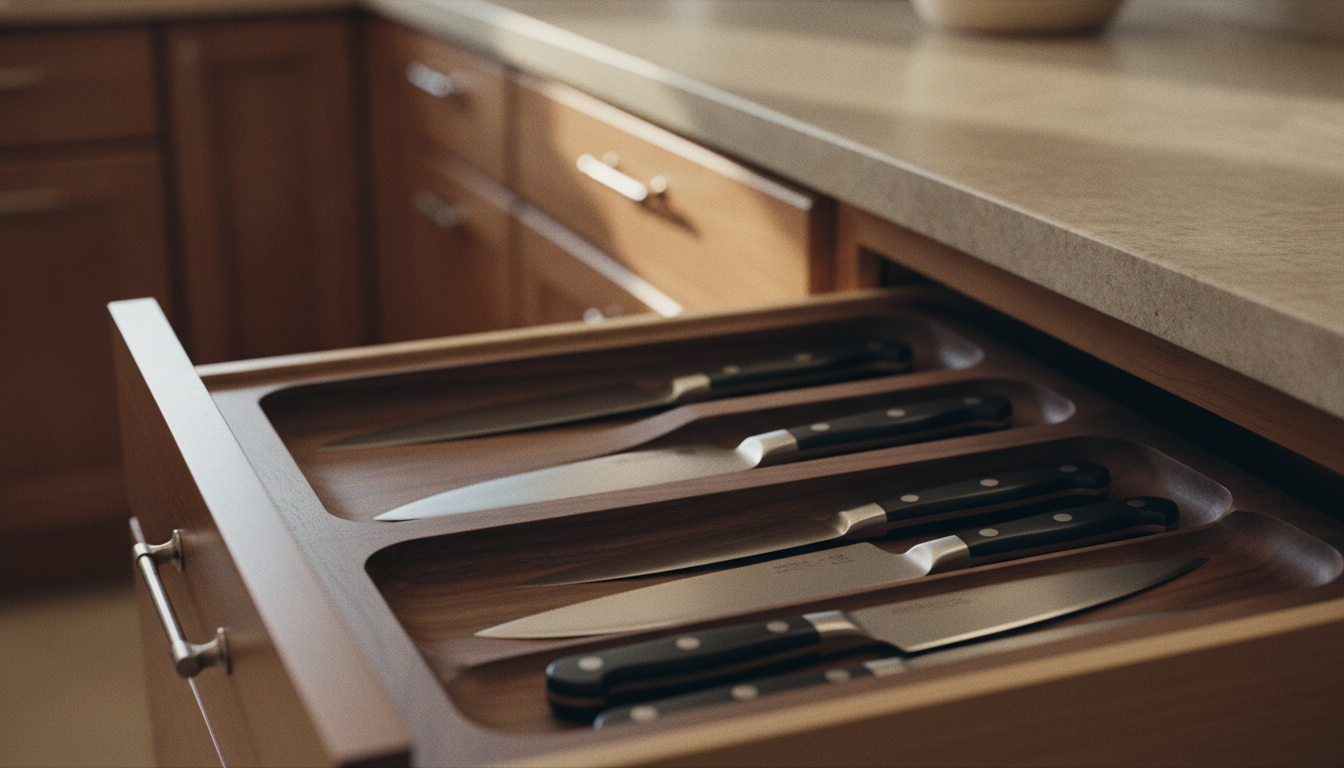
Loose drawer storage causes your knife's edge to chip and dull through repeated metal-on-metal contact, moisture exposure, and poor airflow. Protect your blade by storing it in a dedicated insert with proper separation, support, and safety to keep it sharp meal after meal.
How Loose Drawer Storage Actually Dulls Your Knives: The Science Behind Blade Damage
Metal-on-metal contact inside a loose drawer chips your blade's microscopic edge with every open and close, compounding damage that sharpening alone cannot fix.
Metal-on-Metal Contact: Why Loose Drawers Are a Blade's Worst Enemy
Loose drawer storage puts your knife's edge in direct contact with other metal items -- forks, spatula handles, other blades -- every time the drawer opens, closes, or shifts during use. This matters because a knife's edge isn't a smooth line under magnification; it's a row of microscopic teeth, and those teeth chip or roll when they strike a harder surface [2]. Metal-on-metal contact is one of the fastest ways to dull a knife, since even brief impacts against a hard surface can chip or fold the fine edge [1]. Inside a cluttered drawer, this happens constantly and mostly out of sight:
- Blades sliding against forks, whisks, or other knives
- Metal dividers or drawer walls knocking the edge shut
- Utensils shifting weight onto the blade mid-use
None of this looks dramatic in the moment, but the damage compounds with every open and close. Each contact leaves a small imperfection along the edge, and a jagged edge can't slice cleanly no matter how recently it was sharpened [1]. This is exactly why knife drawer storage dulling shows up so often as a complaint among cooks who toss blades in with everything else instead of separating them from other metal.
Friction, Impact, and Edge Degradation: What Happens Every Time You Open the Drawer
Every time you open or close a loose drawer, the blade experiences a small burst of kinetic energy, sliding contact against neighboring utensils, then a sudden stop as the drawer reaches its limit. That stop-motion jolt transfers impact stress straight into the edge, and impact stress is exactly what thinner, harder blade geometries handle worst, since higher hardness sacrifices toughness and toughness is what lets steel absorb impact without chipping [3]. Repeated opening and closing turns a single knife drawer into a low-grade tumbling chamber, and knife-storage researchers trace the damage back to four distinct mechanisms operating together rather than one obvious cause [4]:
- Direct edge contact against other hard objects
- Sliding friction as items shift during use
- Trapped moisture that speeds corrosion
- Poor airflow that keeps blades from drying
A knife sharpened to a fine edge and then dropped into a cluttered drawer can lose measurable sharpness in as little as a week under these conditions [4]. None of the four mechanisms needs to be severe on its own -- small nicks, thin films of moisture, brief scraping -- but stacked together and repeated daily, they erode an edge faster than normal cutting work ever would.

Should You Store Knives in a Drawer? The Honest Answer for Your Kitchen Setup
Drawer storage wins on sanitation when blades are fully dry and kept separate from other utensils, shielding them from dust and moisture.
When Drawer Storage Makes Sense (And When It Doesn't)
The Sanitary Case for Drawer Storage vs. Counter and Block Methods Sanitation depends more on surface finish and dryness than on whether a knife sits in a drawer, on a counter, or in a block, since bacteria cling far more readily to rough, pitted, or corroded surfaces than to smooth ones [7]. A closed drawer has one clear advantage: it shields blades from airborne dust, grease splatter, and the open exposure that counter knife blocks and magnetic strips can't avoid between meals [7]. Blocks carry a hidden downside for hygiene, since their slots trap moisture and stray crumbs in spots a brush can't reach, while an open dish rack or countertop surface collects dust and residue with no cover at all [7]. Drawer storage only wins that sanitary comparison if the blade goes in fully dry, since home kitchens can't reach the sanitizing temperatures a restaurant dish machine hits, making thorough hand-drying before storage the deciding factor [7]. In practice, the safest setup combines a drawer with a dedicated insert that keeps the blade separated, dry, and out of contact with other utensils:
- Drawer + insert: shielded from dust, low moisture risk
- Open block: exposed to air, slots trap crumbs
- Magnetic strip: exposed to air, easy to wipe clean
- Bare drawer: exposed to metal contact, no protection
Whichever method you choose, a corrosion-resistant blade that's washed and dried after every use will always outperform a reactive or roughened one, regardless of where it's stored [7].
Proven Drawer Storage Solutions That Protect Your Blade Edge
Purpose-built hardwood inserts sized to your exact blades prevent the gaps and blade-to-wall contact that compromise edge protection.
Blade Guards, Sheaths, and In-Drawer Organizers: A Comparison Table of Protection Methods
DIY vs. Purpose-Built Storage: Which Approach Keeps Edges Sharp Longest DIY solutions -- cork liners, 3D-printed inserts, cardboard dividers -- can separate blades cheaply, but their protection depends entirely on how precisely they're built and how well they support the blade's weight [11]. Purpose-built organizers, cut to match blade dimensions and drawer size, keep each edge supported without the trial and error of a homemade fix [12]. Material choice matters too: solid hardwood is gentler on an edge than the plastic filaments used in some universal holders, since a razor-sharp blade can gradually cut into soft plastic over repeated use [10]. A DIY organizer that isn't fitted precisely to your knives leaves gaps where the blade still slides and knocks against the slot walls, undoing the reason for upgrading past a bare drawer in the first place [11]. For a defined knife set that rarely changes, a purpose-built insert sized to those exact blades closes those gaps more reliably than an improvised version:
- DIY cork or foam liners: low cost, inconsistent fit
- 3D-printed inserts: customizable, but require design accuracy
- Purpose-built hardwood inserts: precise slots, consistent support
- Universal plastic holders: flexible sizing, filaments wear under sharp edges
Whichever route you take, the goal stays the same: no blade-to-blade or blade-to-wall contact once the knife is set down.


The Golden Rule for Knife Storage and Your Maintenance Essentials
Proper knife storage requires separation, support, and safety working together to protect both your blades and hands from damage.
Separation, Support, and Safety: The Three Principles That Prevent Dulling
The golden rule for knife storage comes down to three requirements working together: separation, support, and safety. Separation means no blade touches another blade or utensil at any point, since loose knives in a drawer are the biggest safety and blade-damage risk, with edges knocking against other utensils and dulling fast [13]. Support means each blade rests on a surface built to hold it rather than sliding loose enough to knock against slot walls; slots need to be tight enough to keep the tool upright but loose enough to lift out without scraping the sides [15]. Safety covers the cook's hand as much as the edge, since gripping or reaching for a blade stored carelessly raises injury risk, while proper separation protects the edge from chipping against hard surfaces [14]. A quick way to check whether a drawer setup meets all three: shake the drawer gently and listen. Silence confirms the blades are separated and supported; any rattle means edges are still making contact [15].
- Separation: no blade touches metal or another blade
- Support: slot or guard matches the blade's exact shape
- Safety: edge stays clear of fingers and hard surfaces
- Test: a gentle shake should produce no rattle
Pre-Storage Prep and Long-Term Care: Steps to Take Before and After Drawer Storage
Pre-storage prep starts with the same habit that protects any edge: hand wash the blade in warm water, dry it completely, and skip letting it sit in a rack next to other utensils, since standing moisture is what turns a clean edge into a corroded one [16]. Wipe the spine and heel too, since food residue left near the handle can work its way into the bolster over time [17]. For carbon steel blades, a thin coat of food-safe oil before the knife goes into the drawer adds a buffer against rust during the days between uses [18]. Before it goes back into a guard or insert, check the edge for chips or a rolled tip; storing a damaged edge without addressing it just lets the same nick catch on utensils again [17]. Once the knife comes back out for the next meal, a light pass on a ceramic honing rod realigns the edge before it touches a board [16]. Long-term care is this loop repeated: dry before storage, protect the edge while it's away, and confirm the knife is sharp enough to use on the way back out. Make storage part of your regular care & maintenance routine, and a well-kept edge will reward you meal after meal. Still deciding on the right setup for your kitchen? Contact us -- we're happy to help you keep your blades sharp for the long haul.
- Hand wash and dry fully before storing
- Oil carbon steel blades before longer storage
- Check edge for chips before putting away
- Hone lightly after removing knife from drawer
- Loose drawer storage dulls knives through repeated metal-on-metal contact that chips microscopic blade teeth.
- A knife can lose measurable sharpness in one week from four combined damage mechanisms: direct contact, friction, moisture, and poor airflow.
- Purpose-built hardwood inserts outperform DIY solutions by providing precise slots that eliminate blade-to-wall contact.
- Hand wash and fully dry knives before storage, then hone lightly with a ceramic rod after removing from the drawer.
- The shake test confirms proper storage: silence means blades are separated and supported; any rattle indicates edges are still making contact.
- https://artisancutlery.net/blogs/knife-knowledge/maintain-sharp-knives-tips?srsltid=AfmBOooLC890xQwq4SM5KCtbCHY2ozvQ48pMQES38YGiY_PUC2RNYBLG
- https://sonderla.com/blogs/sonder-la-blog/why-titanium-and-stainless-steel-cutting-boards-are-bad-for-your-kitchen?srsltid=AfmBOoqhUOX-4YtZam3Mk8G0Bg_SlOvl2syFVUmNBa9Yb0n8RXx79-dd
- https://leeknives.com/how-to-store-japanese-knives/
- https://japaneseknifelab.com/en/guide/japanese-knife-storage/
- https://www.edgeofthewedge.com/knives-101/how-to-store-your-knives
- https://oishya.com/journal/top-3-ways-to-store-your-kitchen-knives-and-their-pros-and-cons/
- https://www.jayfisher.com/Food_Safety_Kitchen_Chefs_Knives.htm
- https://www.fliproducts.com/pages/knife-storage-faq?srsltid=AfmBOoqd1vunLad8i0i_bXNf21MvE3o7gz2sEYGYVByJ9UMTnZ-e9ZWh
- https://www.fliproducts.com/blogs/tomato-crater/blade-guard-vs-in-drawer-knife-organizers?srsltid=AfmBOorWsjH31HOnguuXBnGyIdOEvn7YtenxR5AHxTU5mU91o-kbjtDB
- https://www.cuisineathome.com/review/knife-holder
- https://www.saafiknife.com/knife-block-vs-drawer-storage-pros-and-cons-you-must-consider.html
- https://dovetailsandstitches.com/blogs/journal/knife-block?srsltid=AfmBOorO6vKHkJtq5XzySXgUqp8sffe7FbMEWjccDMhARD_jGaQndfcB
- https://craftytwisty.com/diy-knife-holder-ideas/
- https://oishya.com/journal/4-ways-to-hold-a-kitchen-knife-safely/
- https://world.taobao.com/lang/en-us/shopping-guide/2006454090111909888.htm
- https://cowboysharp.com/stop-dulling-knife-care-tips/
- https://www.donnguyenknives.com/blog/how-to-maintain-kitchen-knives
- https://wickedhandy.net/kitchen-knife-care-and-maintenance/
- Summary
- How Loose Drawer Storage Actually Dulls Your Knives: The Science Behind Blade Damage
- Should You Store Knives in a Drawer? The Honest Answer for Your Kitchen Setup
- Proven Drawer Storage Solutions That Protect Your Blade Edge
- The Golden Rule for Knife Storage and Your Maintenance Essentials
- Key Takeaways
- References